
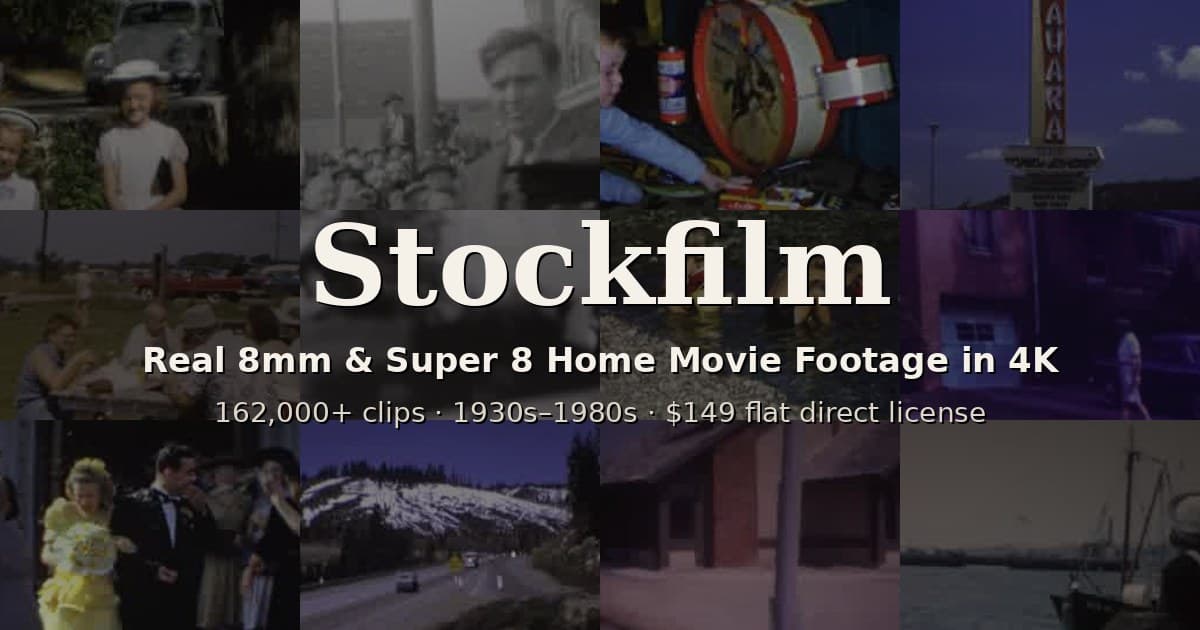
When a Belgian cyclist’s mid-race biology break became minor sporting lore, the documentary value wasn’t in the aesthetic of “retro cycling footage.” It was in the specificity of the moment: Victor Campenaerts, that specific race, that particular bottle, captured on chemically-processed film by someone who happened to be there. When that footage surfaced in May 2026, it illustrated something critical that AI-generated video cannot replicate—verifiable, geotemporal singularity.
We have entered an age where synthetic media can generate a convincing “1980s peloton” in seconds, complete with grain, light leaks, and period-correct kit. Yet these generated moments are probabilistic averages—plausible but non-specific. For documentary teams, heritage producers, and news editors, this creates a new procurement crisis: the need to distinguish between vintage aesthetic and vintage evidence. The solution is not better AI detection software, but a return to chemically-verified 8mm and Super 8 footage that is physically bound to the moment it recorded.
The Specificity Gap in Synthetic Archives
AI video generators excel at generality. They can produce a convincing “rave in Manchester circa 2003” or a “football match from the 1986 World Cup” that looks authentic at first glance. But these are synthetic averages drawn from training data—composite ghosts of many moments rather than the chemical record of one. When audiences and distributors increasingly question the provenance of every frame, generic nostalgia becomes a liability.
Recent documentary productions—ranging from the Warehouse Project’s twentieth-anniversary archive to the 1986 World Cup retrospective The Match—demonstrate that credibility now hinges on the unrepeatable detail. Viewers aren’t just seeking texture; they are seeking proof that what they’re watching occurred at a specific coordinate in time and space. AI cannot provide this because it lacks the causal chain between photons hitting celluloid and the chemical reaction that fixed them. It generates scenarios; archival film captures incidents.
Chemical Verification as Geotemporal Evidence
Unlike digital files or generated content, 8mm film is a physical artifact of duration. The chemistry of the emulsion, the batch of the stock, the specific lens flare caused by a particular factory coating—these elements create a fingerprint that ties the image to a specific camera, a specific roll, and a specific moment. When preserved according to archival standards, this material provides what might be called “geotemporal anchoring”: the irrefutable proof that the image existed before the algorithm did.
This matters for productions facing heightened scrutiny. In an environment where AI-generated clips of world leaders circulate as fact, documentary teams need footage that carries its own evidentiary weight. The specific grain structure of Kodachrome II, the particular color shift of aged acetate, and the documented chain of custody from camera to archive create a material argument that synthetic media cannot counterfeit. It is not merely “old-looking”; it is historically located.
When the Moment Matters More Than the Look
The shift toward specificity is reshaping three key production verticals:
Sports Heritage Documentation The resurgence of historical sports documentaries—exemplified by projects revisiting the 1986 World Cup—requires footage of specific plays, not generic “vintage football.” AI might generate a plausible goal celebration, but it cannot recreate the particular geometry of Maradona’s run or the specific crowd reactions captured by a fan’s Super 8 camera in the stands. For these productions, chemically-verified archival collections provide the only legally defensible visual evidence.
Music and Subcultural Archives The Warehouse Project’s anniversary film highlights another specificity frontier: the documentation of ephemeral cultural moments. Rave culture, punk gigs, and DIY scenes existed in specific rooms with specific lighting rigs and specific fashion choices. Generic “90s club footage” lacks the architectural detail of the actual venues, the particular brand of cigarettes smoked, the exact model of synthesizer on stage. These details authenticate the historical claim; their absence signals synthetic substitution.
News Verification and Editorial Content As newsrooms navigate the deepfake crisis illustrated by recent synthetic political videos, the demand for pre-verified specific moments has intensified. When covering historical events or verifying contemporary claims against archival record, editors require footage that is chemically tied to the event itself—such as the Campenaerts incident—rather than illustrative recreations. The liability of using generated “archival style” content in news contexts has made specificity a risk management priority.
Implications for the Licensing Workflow
This shift changes how editors approach the “empty timeline to locked cut” workflow. Rather than searching stock libraries for “vintage feel” and worrying about authentication later, teams are increasingly front-loading provenance requirements. The new workflow treats chemically-verified 8mm as infrastructure rather than decoration—material that must be sourced before the rough cut can be considered structurally sound.
Building the Specificity Check
When evaluating archival footage for unrepeatable moments, professional teams now prioritize:
- Chemical batch documentation – Verifying the stock manufacturer and processing date to align with the claimed historical moment
- Geotemporal consistency – Cross-referencing architectural details, vehicle models, and fashion against the specific date and location
- Chain-of-custody verification – Ensuring the footage moved directly from camera to archive without digital intermediation that could compromise its status as primary source
- Comparative forensic analysis – Matching grain structure and lens characteristics against other verified footage from the same era and equipment
FAQ
How do I verify that an archival moment is “unrepeatable” and authentic rather than AI-generated?
Look for chemical verification markers inherent to film stock: the specific dye layers of reversal film, the characteristic fading patterns of acetate versus polyester bases, and the physical edge codes that indicate manufacturing batches. Reputable archival sources provide documentation of the stock’s chemical provenance and scanning history. Unlike AI-generated content, authentic 8mm contains noise patterns and optical imperfections that are mathematically irreproducible.
Can’t AI eventually recreate specific historical events if trained on enough photographic data?
AI systems interpolate from existing data; they do not witness events. Even with extensive training, they produce probabilistic reconstructions that lack the causal link between light and chemistry. A generated “Maradona goal” will be a composite of all goals, subtly wrong in the specific positioning of shadows, the physics of the ball, or the reactions of identifiable individuals. For legal and ethical reasons, documentary production requires the evidentiary certainty that only original capture provides.
Does sourcing specific, verified archival footage cost more than generic stock?
Chemically-verified, moment-specific footage typically commands a premium over generic “vintage style” content, whether AI-generated or modern stock. However, this cost is offset by reduced legal risk (avoiding defamation or misrepresentation claims), faster clearance workflows (pre-verified provenance), and the insurance value of having distributor-proof authenticity documentation. In an era of synthetic media skepticism, the specificity premium is increasingly viewed as a necessary production cost rather than a discretionary upgrade.
Conclusion
The documentary industry is moving beyond the “texture economy” into what might be called the “specificity economy.” As synthetic media floods the market with convincing but generic pasts, the competitive advantage lies in footage that carries its own history—chemically embedded, geographically fixed, and legally defensible. For producers navigating the tension between Adobe-style workflow velocity and the authentication demands of modern distribution, the unrepeatable moment captured on 8mm film offers something AI cannot: certainty that what you see is what actually happened.