The Conservancy’s 2026 celebration marks 25 years of stewardship. Its anniversary fundraising supports the preservation of the Merritt Parkway, its distinctive bridges and its designed landscape. This footage board offers wider Connecticut context for telling that story; it does not establish a commissioned film or a need for particular shots. [1]
The Conservancy’s guide encourages people to see the parkway as a connection between communities and places to visit, with attention to bridges, trees, waterways and nearby town centres. The proposed sequence starts with early motoring, continues into the postwar decades and looks outward to the places and everyday outings around it. Each clip keeps its own catalog location. [2]
Footage for this production
Watch the 30-second selection
Real 8mm home movies. No AI-generated or recreated footage. Dates and places are catalog estimates. Preview and license the individual clips below.
Cut from your bin
A first pass through the selection
An opening idea following The town around the car, Danielson, 1939; A day out in New London, 1969; Arrival and road travel; Buildings and signs at street level; Winter roads and snowy surroundings; People in everyday places. The date and place labels follow the catalog entries on the cards below.
01 → 07 → 15 → 17 → 19 → 22
Recommendations connect catalog descriptions, dates and shooting locations to the production brief. Cards with still review link to the inspected image and record what it shows. Full playback and source-reel research are the next steps before the edit.
Production approach
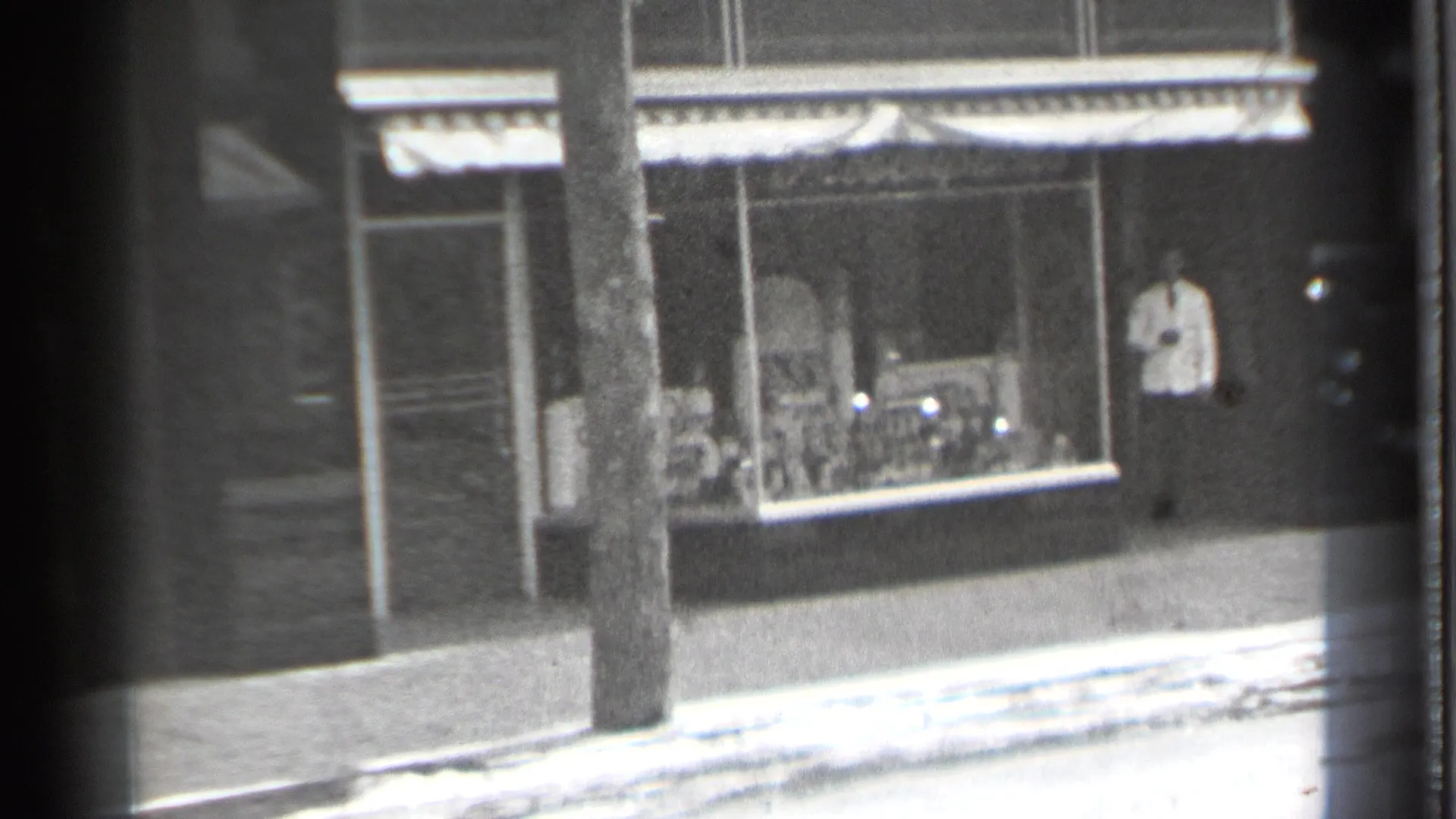
The town around the car, Danielson, 1939
End among storefronts and passing traffic, keeping the distinction between a town street and a landscaped parkway visible. [3]
The Conservancy’s history describes a limited-access road that combined transport, architecture and landscape. Town streets provide a useful point of comparison for that designed environment. The catalogued Connecticut views below can supply period texture, with no claim that their buildings, vehicles or streets belong to the parkway corridor. [3]
Proposed scene needs: street, storefront, building, traffic, sidewalk · Danielson, Connecticut · 1939–1939. These describe the research brief; each candidate’s catalog date and place appear below.
Give the journey a human purpose with outings, arrivals and time spent outdoors. [2]
The Conservancy’s guide connects driving with places to visit. These New London scenes offer a later Connecticut outing as a clearly labelled contrast to the 1939 Danielson material. They do not identify a destination on the Merritt route, and the proposed edit must not suggest that these people reached the coast by that road. [2]
Proposed scene needs: boardwalk, parking, bench, courtyard, recreation, venue · New London, Connecticut · 1969–1969. These describe the research brief; each candidate’s catalog date and place appear below.
Find identified parkway views to anchor the wider Connecticut context. [2]
The Conservancy’s own guide draws attention to bridges, trees, rivers and stone walls. Identified views of the Merritt would anchor those subjects in an edit. This catalog selection does not establish that coverage, so the gap stays open for a separate archive search rather than using an unrelated bridge or woodland as if it belonged to the parkway. [2]
Proposed scene needs: Merritt Parkway, parkway bridge, wooded road, stone wall · Connecticut · 1930–1969. These describe the research brief; each candidate’s catalog date and place appear below.
No selected clip currently supports this scene need. A separate archive search is required.
Production approach
Arrival and road travel
Begin with the everyday scale of motoring: vehicles, passengers and the first movement away from a stopping place. In this chapter, the proposed edit would give the edit a way into and between places through catalogued travel scenes. [3]
Begin with the everyday scale of motoring: vehicles, passengers and the first movement away from a stopping place. In this chapter, the proposed edit would give the edit a way into and between places through catalogued travel scenes. [3]
Proposed scene needs: car, automobile, driving · Danielson, Connecticut · 1939–1939. These describe the research brief; each candidate’s catalog date and place appear below.
Begin with the everyday scale of motoring: vehicles, passengers and the first movement away from a stopping place. In this chapter, the proposed edit would give the location recognizable built detail without presenting regional buildings as a named institution. [3]
Begin with the everyday scale of motoring: vehicles, passengers and the first movement away from a stopping place. In this chapter, the proposed edit would give the location recognizable built detail without presenting regional buildings as a named institution. [3]
Proposed scene needs: car, automobile, driving · Danielson, Connecticut · 1939–1939. These describe the research brief; each candidate’s catalog date and place appear below.
Begin with the everyday scale of motoring: vehicles, passengers and the first movement away from a stopping place. In this chapter, the proposed edit would establish the season and approach to a place while preserving the actual catalog geography. [3]
Begin with the everyday scale of motoring: vehicles, passengers and the first movement away from a stopping place. In this chapter, the proposed edit would establish the season and approach to a place while preserving the actual catalog geography. [3]
Proposed scene needs: car, automobile, driving · Danielson, Connecticut · 1939–1939. These describe the research brief; each candidate’s catalog date and place appear below.
Begin with the everyday scale of motoring: vehicles, passengers and the first movement away from a stopping place. In this chapter, the proposed edit would bring the setting to a human scale through the described everyday activity, without assigning identities. [3]
Begin with the everyday scale of motoring: vehicles, passengers and the first movement away from a stopping place. In this chapter, the proposed edit would bring the setting to a human scale through the described everyday activity, without assigning identities. [3]
Proposed scene needs: car, automobile, driving · Danielson, Connecticut · 1939–1939. These describe the research brief; each candidate’s catalog date and place appear below.
These are broader Connecticut scenes from Danielson in 1939 and New London in 1969. No clip is established as showing the Merritt Parkway, one of its bridges or a journey along it.
The 1939 and 1969 scenes are separate reels and occasions. They should not be joined as one family’s continuous trip.
Catalog descriptions, dates and places have been checked as metadata. No full playback or frame-based review is claimed.
The Conservancy’s anniversary is the institution’s milestone, not the age of the roadway.
Use the preview to check the action and framing, then verify the catalog date, shooting place and original reel. Review the license on the clip page for the intended use; matching a project theme does not establish rights or releases.
Open a clip using its Preview and licensing link, then choose License Direct to check the permitted usage and pay on Stockfilm. Direct licensing is $149 per clip for the restored 4K master, available to download after payment. Editorial-only restrictions and any required review are shown before purchase. This research page is free to browse; footage is licensed separately. [4]
How should I compare these shots for the edit?
Start with the proposed production use on each card. Watch the complete preview for action, framing and usable duration, then compare alternate views within the same theme. Check the source reel, shooting place and date before writing a specific caption or narration.
How do I choose the right license?
Open the clip page to review its current editorial or commercial permissions for your planned distribution. The licensing guide explains the available terms; a production-specific rights review can address releases and third-party material.
What should I include in a follow-up footage request?
Send the intended scene, shooting location, year range and production use, along with the candidate IDs that interest you. A precise brief makes it easier to find missing coverage and compare shots from the same source reel.
Public evidence
Research sources
Sources for the project context and proposed production approaches.