
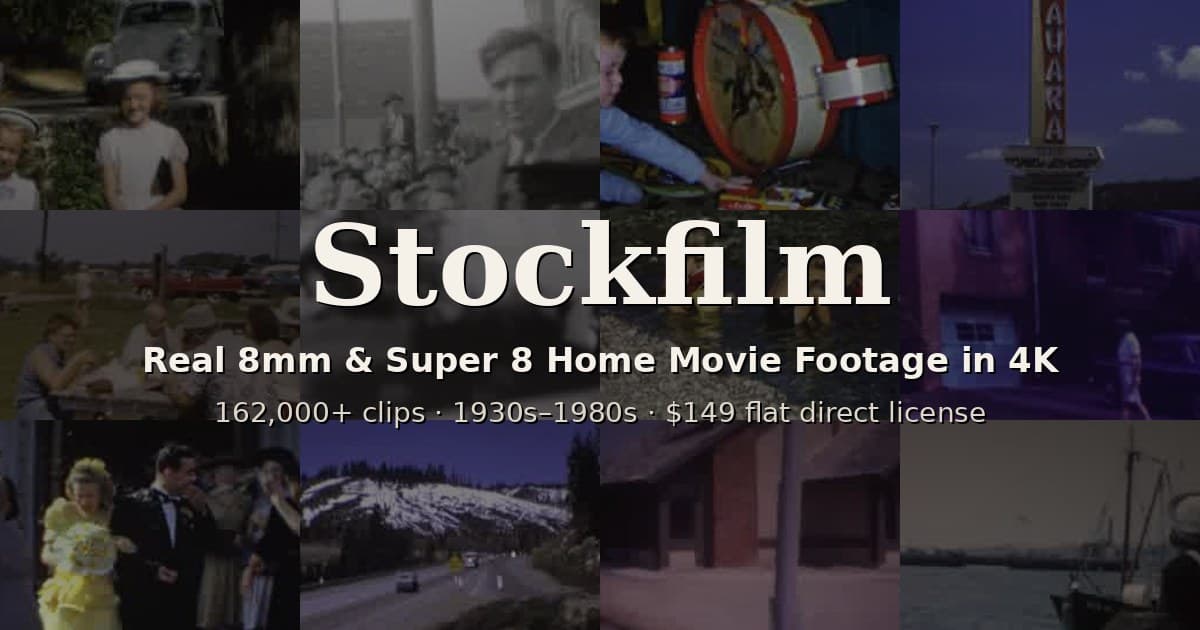
When National Geographic announced Time and Water, its latest documentary exploring hydrological change through archival lenses, the production team faced a dilemma familiar to modern documentarians: how do you visualize environmental transformation when audiences increasingly distrust moving images? The answer, for an growing number of producers, lies not in generative AI or digital upscaling, but in returning to the chemical emulsion of 8mm and Super 8 film—material that carries an immutable timestamp within its very structure.
The Evidentiary Weight of Analog
Environmental storytelling operates on a specific evidentiary standard. To demonstrate coastal retreat, glacial melt, or riparian degradation, documentary teams require footage that functions as primary source material—images captured at specific historical moments without subsequent algorithmic interpolation. This is where chemically-verified 8mm footage distinguishes itself from both modern digital capture and AI-generated content.
Unlike digital files, which can be manipulated, backdated, or synthetically generated with increasing sophistication, 8mm film stock operates on photochemical principles that resist tampering. When light strikes silver halide crystals suspended in gelatin emulsion, the resulting latent image becomes a physical artifact of that specific moment in time. The chemical processing required to develop the film—temperature logs, chemical baths, drying records—creates a parallel documentation trail that digital formats simply cannot replicate.
For productions documenting environmental change, this material authenticity serves as a bulwark against the "synthetic skepticism" now pervasive in documentary distribution. Distributors and fact-checkers increasingly scrutinize environmental footage for signs of AI generation or manipulation, particularly following high-profile controversies involving fabricated natural disaster imagery and interpolated wildlife sequences.
Baseline Documentation: The Archival Anchor
The most critical application of authentic vintage footage in environmental documentary work lies in establishing historical baselines. Producers working on long-term change narratives require "before" imagery that withstands forensic scrutiny—footage that proves, materially, that a particular glacier once extended to a specific coordinates, or that a wetland previously supported certain vegetation patterns.
Consider the practical applications across documentary sub-genres:
- Coastal erosion documentation: Pre-digital era beach footage provides irrefutable comparison points for modern shoreline positions, bypassing disputes about digital image manipulation or GPS coordinate errors.
- Glacial retreat visualization: 1970s and 1980s alpine footage captured on Super 8 offers texture and atmospheric conditions that serve as authentic visual benchmarks, distinct from the "uncanny valley" smoothness of AI-upscaled content.
- Wetland degradation studies: Vernacular footage of recreational fishing, boating, or riverside communities often contains incidental environmental data—water levels, vegetation density, wildlife presence—that proves invaluable for ecological historians.
- Urban heat island historical baselines: Residential footage from the 1960s-1980s frequently captures tree canopy coverage, impervious surface ratios, and architectural shading patterns that inform current climate resilience planning.
- Agricultural land use transitions: Farm and rural community footage documents crop patterns, soil management practices, and irrigation infrastructure prior to modern industrial methods.
These applications require footage that maintains material provenance—clear chain-of-custody documentation from original capture through digitization. When producers license such footage through specialized archival houses, they receive not merely a video file, but a chemically-authenticated historical record.
The Enhancement Trap
Recent advances in AI video enhancement tools promise to restore "old, soft, and noisy footage to cinematic 4K" through algorithmic interpolation. While technically impressive, these processes introduce a fatal complication for environmental documentary work: they create pixels that never existed, effectively manufacturing historical evidence.
For legal, academic, and journalistic contexts, this distinction matters profoundly. An AI-enhanced image of a 1970s coastline might smooth away the grain that authenticates the era, or worse, hallucinate details—vegetation, water lines, structural elements—that compromise the footage's utility as comparative evidence. The result is content that looks pristine but functions as interpretive reconstruction rather than documentary record.
Authentic 8mm footage, by contrast, maintains what preservationists call "chemical honesty." When scanned via optical 4K systems, the original grain structure remains intact, providing the organic texture that distinguishes genuine archival material from synthetic approximations. This distinction becomes particularly crucial when footage may be submitted as evidence in environmental litigation, policy white papers, or museum installations where material authenticity carries institutional weight.
Practical Procurement for Environmental Productions
Documentary teams integrating archival footage into climate narratives should approach licensing with specific technical criteria. The footage must be sourced from collections that maintain rigorous preservation standards, including cold storage histories, vinegar syndrome monitoring, and digitization protocols that prioritize frame-accurate scanning over algorithmic enhancement.
Producers should request:
- Chain-of-custody documentation verifying the footage has not undergone undocumented digital manipulation
- Chemical processing dates that align with the historical period being documented
- Scanning specifications confirming optical rather than interpolated capture
- Metadata packages including camera stock identification (Kodachrome, Ektachrome, etc.) that correlates to specific eras
These requirements reflect a broader shift in documentary production values. As recent documentary series have demonstrated, audiences and distributors increasingly prize material transparency over visual polish. The slight gate weave, the organic grain storm, the chemical color shifts of vintage 8mm—these "imperfections" serve as authenticating signatures in an era of synthetic perfection.
Frequently Asked Questions
How does chemically-verified footage differ from AI-upscaled archival content?
Chemically-verified footage maintains the original photochemical reaction captured at the moment of exposure. Every frame represents light that physically struck film emulsion at a specific historical instant. AI-upscaled content, conversely, uses machine learning to generate new pixels between existing ones, effectively creating visual information that did not exist in the original capture. For environmental documentation, this distinction separates primary source material from interpretive reconstruction.
Can authentic 8mm footage be used in high-resolution deliverables without AI enhancement?
Yes. Modern optical scanners can capture 8mm and Super 8 film at 4K resolution or higher while preserving the original grain structure and photochemical characteristics. This process creates high-resolution masters that retain the organic texture of film—distinguishing them from the synthetic smoothness of AI-generated or AI-enhanced content—without introducing algorithmic artifacts that compromise evidentiary validity.
What documentation should producers request for environmental documentary usage?
Producers should secure chain-of-custody records establishing continuous possession since original processing, chemical dating verification through edge code analysis or processing lab records, and digitization logs specifying optical scanning parameters. For projects with potential legal or academic applications, requesting raw scan files (without color grading or stabilization) preserves the footage's status as unmanipulated primary source material.
Conclusion
As Time and Water suggests, the most compelling environmental stories require audiences to trust what they see. In an atmosphere of deepening skepticism toward digital imagery, chemically-verified 8mm footage offers something increasingly rare: temporal irrefutability. For documentary teams navigating the complex ethics of climate storytelling, that material certainty may prove as valuable as the images themselves.