
When Bam Margera appears in the final Jackass installment, he will not step onto a new set. Following highly publicized legal disputes and health concerns that made fresh filming impossible, Margera’s presence will be constructed entirely from archival footage—decades of chemically-processed 8mm and Super 8 material capturing the irreverent chaos that defined the franchise’s early years. This is not a nostalgic bonus feature. It is a production necessity.
The Margera case is not isolated. In recent months, the Michael Jackson Estate unveiled a new “Human Nature” music video blending contemporary choreography with vintage archival material, while a forthcoming WWII documentary narrated by Tom Hanks relies on newly unearthed footage to circumvent the impossibility of filming deceased veterans. Collectively, these projects signal a fundamental shift in how professional teams approach talent access crises. Rather than resorting to synthetic AI-generated performances—a strategy increasingly vulnerable to the “slopaganda” debunking we see dominating fact-checking headlines—producers are treating authentic archival footage as primary production infrastructure, not supplemental illustration.
The Access Crisis: When New Filming Is Legally or Physically Impossible
Modern productions face a convergence of constraints that make traditional talent acquisition high-risk or impossible. The Jackass scenario represents the legal exclusion category: contractual disputes, restraining orders, or insurance liabilities that physically bar talent from set, yet contractual obligations or narrative continuity demand their presence. For documentary teams, the challenge often involves estate-controlled figures where surviving family members restrict new interviews but control vast libraries of home movies, or historical subjects where temporal distance makes new capture impossible.
The market response has been bifurcated. On one side, AI video generators promise synthetic resurrection—digital puppets that mimic performance. Yet the same week the Jackass archival strategy was announced, Snopes published debunkings of AI-generated wildlife footage masquerading as documentary evidence, while CityNews Calgary reported on “Slopaganda” campaigns using synthetic video to manipulate political narratives. The authenticity infrastructure surrounding AI-generated talent remains catastrophically fragile, exposing productions to reputation-destroying fact-checks and audience betrayal.
The Chemical Alternative: Archival Footage as Casting Strategy
Against this backdrop, chemically-verified 8mm and Super 8 footage offers a distinct value proposition: material testimony that cannot be statistically faked. When a documentary editor cuts to a 1970s Kodachrome frame of a young performer or a WWII soldier, they are presenting light that actually passed through a lens and struck emulsion—physical evidence with chain-of-custody documentation that satisfies legal clearance teams and skeptical audiences alike.
This creates three specific production workflows increasingly common in 2026 licensing markets:
- The Legal Workaround: For franchises or continuing series facing talent exclusion, vintage home movies and behind-the-scenes 8mm footage provide the only legally viable path to include controversial or restricted figures without new contractual negotiations or on-set liability.
- The Estate Collaboration: For legacy artists and deceased historical figures, archival footage serves as the "performance" itself—allowing estates to release new content (music videos, documentaries, biographical series) without resorting to AI voice synthesis or deepfake visual recreation, which face growing ethical and regulatory scrutiny.
- The Temporal Bridge: For historical documentaries where subjects are deceased, archival methodology focuses on chemically-processed footage that provides the granularity of micro-expressions, environmental details, and lighting physics that actors cannot replicate and AI cannot generate without detection.
Verification Infrastructure and Post-Production Integration
The strategic value of archival footage in these scenarios depends entirely on verification protocols. Productions using vintage material to substitute for unavailable talent must demonstrate that the footage is chemically authentic—not AI-upscaled beyond recognition or digitally fabricated.
This requires working with archives that provide:
- Material provenance documentation establishing chain of custody from original camera negative to digital scan
- Chemical decay pattern analysis that serves as a forensic fingerprint (synthetic media cannot replicate the specific dye fading, grain clumping, or emulsion scratching of organically aged film)
- Optical physics verification confirming that lighting, lens distortion, and depth-of-field characteristics match the claimed era and equipment
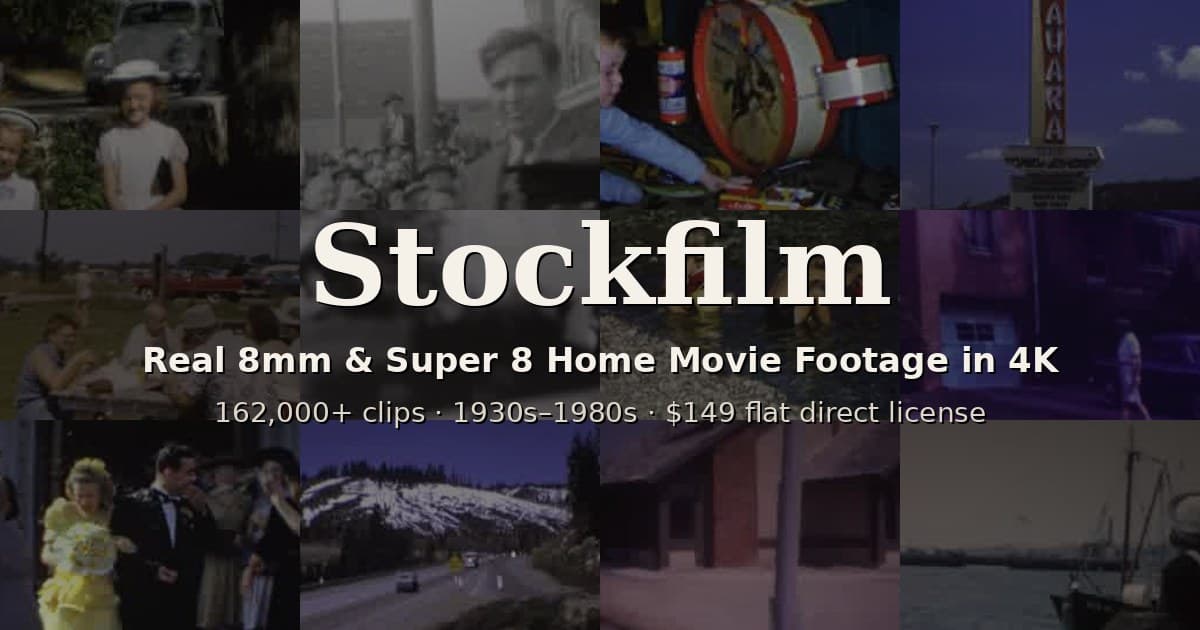
At Stockfilm, preservation workflows emphasize these material markers specifically because they function as legal evidence in documentary contexts. When a production licenses 8mm footage to stand in for an unavailable performer, the chemical imperfections become assets—verification markers that protect against the authenticity challenges plaguing AI-generated content.
Practical Implications for Licensing Teams
For producers, editors, and archival researchers navigating talent access crises, this shift requires rethinking sourcing strategies:
- Rights Architecture: Archival footage used as "casting" requires different clearance packages than B-roll. Ensure estate agreements or talent releases cover "new work" usage, not just historical documentary context.
- Technical Specifications: Authentic 8mm footage intended for primary narrative use demands higher-resolution scanning (4K minimum) and careful restoration workflows that preserve grain structure—over-processing destroys the material authentication that provides the footage its strategic value.
- Audience Positioning: Marketing materials should subtly signal authenticity. In an era of AI skepticism, emphasizing "chemically-verified archival footage" or "original 8mm capture" functions as a trust signal distinct from synthetic alternatives.
FAQ
Can archival footage legally substitute for new talent appearances in commercial productions? Yes, provided the licensing agreement covers the specific usage. For talent who are deceased or legally restricted from new filming, estate agreements and archival releases can provide the necessary rights. The key distinction is that archival footage represents a historical record rather than a new performance, often falling under different contractual categories than on-camera work.
How do production teams verify that vintage footage is authentic and not AI-generated? Authentic 8mm and Super 8 footage exhibits specific material characteristics that current AI models cannot replicate: organic grain structures tied to specific film stocks (Kodachrome, Ektachrome), chemical dye fading patterns, and optical imperfections inherent to analog lenses. Working with archives that provide material provenance documentation and chemically-based authentication protocols—rather than relying solely on digital metadata—provides the forensic certainty required for high-stakes productions.
What are the cost implications of using archival footage versus AI generation or reshooting? While high-resolution archival licensing and restoration carry upfront costs, they often eliminate the hidden expenses of synthetic media verification (legal review for AI likeness rights, fact-checking vulnerabilities, and potential reputation damage from detected fakes) or the logistical impossibility of reshooting historical periods. For talent-access crises, archival footage frequently represents the only viable path to completion, making it a risk-mitigation investment rather than a line-item cost.
Conclusion
As productions from extreme sports franchises to WWII documentaries grapple with talent unavailability, the industry is witnessing a decisive pivot from synthetic generation to material authentication. The chemically-processed 8mm frame—imperfect, time-weathered, and legally defensible—has evolved from historical illustration to essential casting infrastructure. For producers navigating the twin pressures of access restrictions and audience skepticism, authentic archival footage offers something AI cannot manufacture: proof of presence.