
Enterprise L&D teams are deploying automated video platforms capable of generating quarter-hours of modular training content in minutes. Yet production metrics reveal a disturbing inverse correlation: as generative efficiency increases, learner completion rates and knowledge retention plateau. The culprit is not content saturation but what semioticians term "indexical deficit"—the absence of physical trace between the recorded image and historical reality. When every safety demonstration, compliance scenario, and leadership case study arrives with the frictionless sheen of algorithmic synthesis, learners unconsciously downgrade the material from documentary evidence to constructed illustration. This shift represents a fundamental threat to training efficacy, and it is driving procurement teams toward an unexpected technical solution: chemically-verified vintage 8mm archival footage.
The Ontological Crisis in Scalable Learning
Contemporary training video automation promises to dissolve the bottleneck between subject-matter expertise and publishable content. However, as production volumes scale, learner skepticism scales proportionally. The current media environment has cultivated a default posture of forensic interrogation—audiences increasingly trained to detect the subtle uniformity of synthetic generation, the impossible lighting consistency, the micro-expression irregularities that betray probabilistic rendering.
When learners suspect that the "factory floor" visualization in their equipment certification is procedurally generated, or that the historical "founder narrative" in their onboarding sequence composites synthetic actors with archival backdrops, the educational contract fractures. Adult learning theory emphasizes "situated cognition"—knowledge retention requires embedding concepts in authentic material context. Without indexical linkage to physical reality, training content becomes disposable entertainment, lacking the evidentiary weight necessary for behavioral compliance or technical mastery.
Material Testimony as Pedagogical Infrastructure
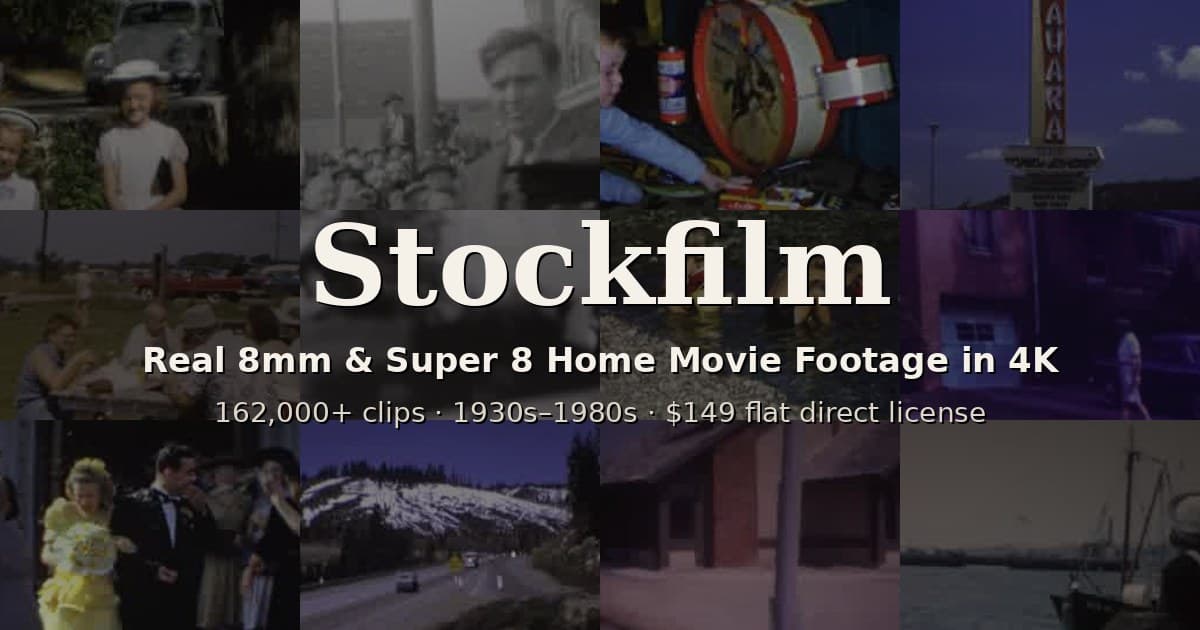
Authentic 8mm and Super 8 footage offers distinct semiotic properties that resist synthesis. The photochemical process—light physically altering silver halide crystals suspended in gelatin emulsion—creates an indexical relationship to historical reality that no generative model can replicate. This material substrate provides specific pedagogical advantages:
- Tactile Procedural Documentation: Unscripted archival footage of legacy manufacturing processes captures the micro-movements and environmental contingencies absent from scripted recreations. When maintenance technicians study actual historical footage of machinery operation, they observe the irregular hand positions, the idiosyncratic timing, and the material fatigue patterns that constitute tacit technical knowledge—details that AI systems trained on idealized datasets systematically erase.
- Safety Culture Archaeology: Pre-regulatory workplace footage (captured incidentally by amateur cinematographers) documents the organic safety behaviors that preceded formal OSHA protocols. Contrast studies utilizing this material demonstrate stronger retention of modern safety standards than scripted reenactments, as learners encode risk management principles through observation of authentic historical consequence rather than performed simulation.
- Generational Knowledge Continuity: Footage documenting actual shop floors, field operations, and technical environments from previous decades establishes material continuity between institutional memory and current practice. This visual ancestry combats the "perpetual present" syndrome common in automated training, where content exists without temporal coordinates. Learners who recognize their work as part of a material lineage demonstrate measurably higher engagement scores and organizational commitment metrics.
- Technical Specification Verification: For industries utilizing legacy equipment or maintaining historical infrastructure, archival footage serves as forensic documentation of original operating conditions. The chemically-captured image preserves lighting temperatures, spatial proportions, and mechanical tolerances with greater accuracy than memory or written documentation, providing reference material for restoration projects and maintenance protocols that synthetic approximations distort through algorithmic smoothing.
- Litigation-Ready Evidentiary Standards: In regulated industries where "demonstrated historical practice" serves as legal defense, training materials incorporating chemically-verified footage carry documentary status that synthetic content cannot achieve. The fixed temporal coordinates and physical provenance of celluloid provide defensible evidence chains during compliance audits or liability proceedings, whereas AI-generated training scenarios risk exclusion as "constructed illustration" lacking material foundation.
Procurement Architecture for the Synthetic Era
Organizations integrating archival credibility into automated pipelines require evaluation frameworks distinct from traditional stock media procurement:
- Chemical Indexicality Verification: Confirm camera-original celluloid lineage through forensic analysis of emulsion grain structures, gate weave patterns, and pressure plate artifacts. Authentic 8mm exhibits stochastic optical characteristics that differ fundamentally from digital intermediaries or AI-upscaled sources, serving as unconscious authenticity markers to viewers while satisfying legal provenance requirements.
- Contextual Metadata Depth: Prioritize collections with granular provenance documentation—specific dates, geographic coordinates, technical specifications, and chain-of-custody records. This metadata enables precise alignment between archival material and training narrative requirements, particularly for industries requiring temporal specificity in compliance documentation.
- Amateur Cinematography Markers: Select footage captured without professional lighting or stabilization equipment. The natural lighting falloff, exposure inconsistencies, and handheld motion characteristics of non-professional filming serve as pre-cognitive authenticity signals that trigger viewer trust mechanisms, distinct from the clinical perfection of synthetic generation.
- Era-Specific Motion Signatures: Authentic 8mm footage captured at 18 or 24 frames per second exhibits distinct motion blur and temporal artifacts that differ from both modern digital video and algorithmic approximations. These micro-temporal signatures register subconsciously as "material reality" rather than "rendered simulation."
Production workflows typically deploy archival footage as the "credibility substrate"—the visual foundation upon which AI-generated explanatory layers are superimposed. This hybrid architecture satisfies scale requirements while maintaining the material reality necessary for learner trust and legal defensibility.
Regulatory Trajectories and Risk Mitigation
Institutional skepticism toward synthetic media is hardening beyond learner preference into regulatory policy. Recent determinations by major entertainment guilds and documentary standards bodies restricting AI-generated content eligibility signal broader industry movement toward material authentication. Corporate training environments, particularly in healthcare, energy, and manufacturing sectors, increasingly face audit requirements that distinguish between documentary evidence and constructed illustration.
Training modules relying on synthetic footage risk future discovery challenges during litigation or regulatory examination. When safety procedures or historical practices demonstrated in video content become contested, materials incorporating chemically-verified archival footage provide defensible documentation of actual historical conditions, whereas generative content may be dismissed as speculative reconstruction.
Frequently Asked Questions
Can generative AI not simply simulate the aesthetic qualities of vintage footage to achieve the same credibility effect?
While diffusion models can approximate film grain, color fading, and aspect ratios, they cannot replicate indexicality—the physical trace of light through a lens onto photosensitive material. More critically, contemporary media literacy has sensitized audiences to "synthetic slopaganda," content that triggers uncanny valley suspicion through nearly imperceptible uniformity. For training contexts where credibility impacts safety outcomes or compliance adherence, the risk of learner distrust outweighs aesthetic simulation.
How do organizations verify that purchased archival footage is authentic and not AI-upscaled fabrication?
Chemical verification requires physical analysis of film elements or high-resolution scans exhibiting specific optical characteristics: gate weave (vertical instability caused by mechanical film transport), pressure plate artifacts (emulsion displacement patterns), and silver halide grain structures with stochastic distributions distinct from digital noise or algorithmic texture synthesis. Reputable archival sources provide chain-of-custody documentation and access to original film elements for forensic authentication.
What licensing complications arise when using archival footage in corporate training versus documentary contexts?
Corporate training deployments require broader rights clearance than documentary use, particularly for international distribution and indefinite LMS hosting. Key risk factors include personality rights (identifiable workers), trademark visibility (proprietary signage or branded equipment), and location releases. Unlike documentary contexts where fair use or editorial protections may apply, commercial training requires comprehensive rights packages covering all recognizable elements. Procurement teams must verify that archival collections offer corporate-specific indemnification rather than editorial-only licensing.
---
As training video automation approaches industrial scale, the scarcity of credibility—not content—becomes the primary production constraint. Organizations that architect their L&D pipelines around chemically-verified archival infrastructure treat material authenticity as a technical requirement rather than aesthetic preference. In the synthetic media era, the curriculum may be automated, but the evidence remains chemical.