
When state media outlets release synthetic propaganda depicting political figures as crude animations, and when viral videos of dogs staging escapes turn out to be algorithmic fabrications, the crisis becomes clear: digital perfection now triggers automatic skepticism. The polished sheen of generated content has expanded the uncanny valley to encompass anything that feels too composed, too intentional, too clean.
For documentary producers and archival researchers, this skepticism creates a production dilemma. When audiences question the authenticity of smartphone footage and digitally captured interviews, how do creators establish temporal trust? The emerging solution lies not in the foreground action of archival frames, but in the background noise—the chemical, optical, and entropic signatures that amateur 8mm footage captures inadvertently.
The Forensic Value of Background Entropy
Synthetic media operates through statistical approximation, predicting pixel values based on training data patterns. It excels at faces, gestures, and dramatic compositions. What it cannot economically replicate is the physical reality of light striking celluloid—the specific chemical reactions, optical imperfections, and material decay that encode temporal certainty in amateur film.
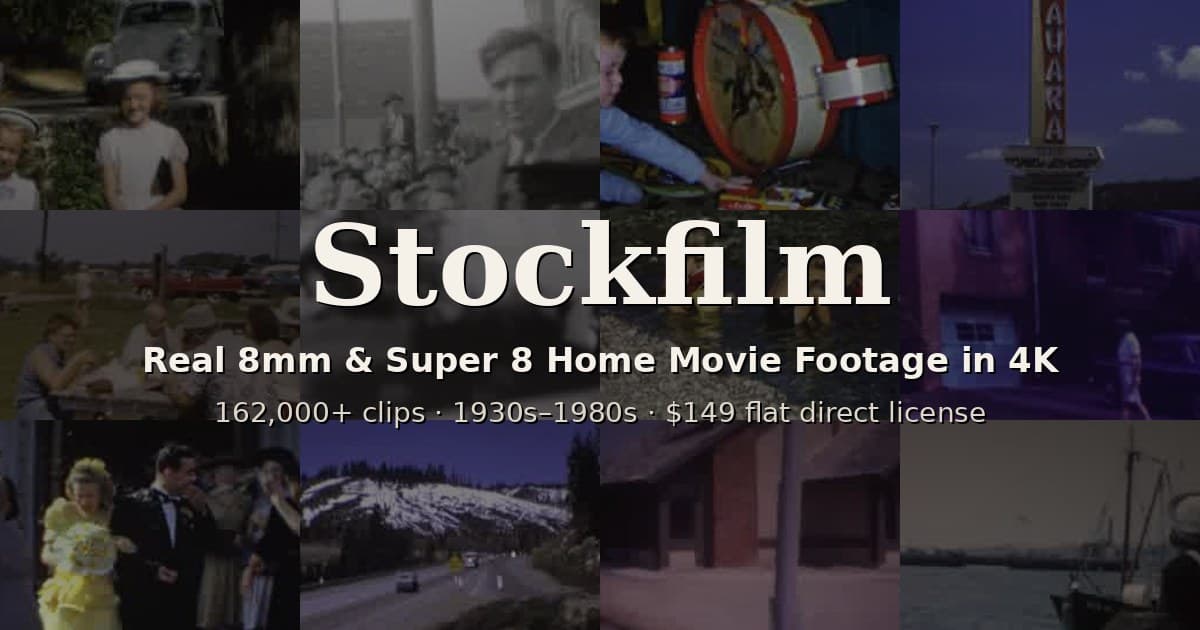
Unlike professional archival materials shot with editorial intent, amateur 8mm footage functions as incidental documentation. The operator focuses on the birthday candle or the tourist landmark while the camera absorbs the peripheral reality: the specific fade of 1970s automotive paint, the reflection of cloud patterns in shop windows, the chromatic shifts of Kodachrome in humid coastal air. These background elements serve as atmospheric metadata—unplanned witnesses to specific moments in physical time.
When reconstructing historical events like the 1999 WTO protests, editors now license amateur footage not for the protest action itself, but for the ambient forensic details: ATM interface designs, coffee cup typography, the specific yellow of taxi cab paint. These elements authenticate eras more effectively than production design because they were never designed; they were simply chemically recorded.
Five Markers of Material Authenticity
The evidentiary value of 8mm footage resides in specific material characteristics that generative models struggle to simulate:
- Chemical Chromatic Signatures: Vintage film stocks captured light through dye layers that degrade in predictable patterns. Kodachrome develops specific magenta shifts in shadow regions after decades of storage, while Ektachrome produces cyan-heavy midtones in low-light conditions. These chemical signatures follow the physics of dye fading rather than digital color channel manipulation, creating chromatic fingerprints specific to emulsion batches and storage environments.
- Optical Physics Artifacts: Consumer 8mm cameras used simple spherical lenses that produced distinct optical phenomena—chromatic aberration along high-contrast edges, spherical distortion at frame peripheries, and specific halation blooming around highlights. These optical signatures follow physical light-bending principles that differ from the algorithmic lens simulations in generative AI, which tend toward idealized or generic distortion patterns.
- Entropic Surface Textures: Film is a physical substrate vulnerable to chemical entropy. Vinegar syndrome creates crystalline patterns in acetate stock. Dust motes on the lens gate burn permanent shadows into frames. Moisture damage produces organic, irregular staining. Unlike digital noise—which follows mathematical algorithms—these material degradations follow chaotic physical processes that AI struggles to replicate convincingly across sequential frames.
- Human Micro-Rhythms: Amateur camera operators adjusted exposure manually, creating temporal micro-inconsistencies: sudden overexposure when moving from shade to sunlight, focus hunting with consumer lenses, handheld tremors at specific frequencies (4-8Hz for human muscle fatigue). These physiological rhythms differ from the algorithmic stabilization or procedural camera noise added to synthetic footage, creating a "biological watermark" of human presence.
- Environmental Entanglement: Film emulsion responded to atmospheric conditions—humidity affecting chemical processing, temperature shifting color balance, air quality affecting clarity. A sequence shot in 1970s Los Angeles carries different particulate signatures than one shot in London during the same era. This environmental entanglement creates location-specific textures that function as chemical testimony to air quality, light temperature, and climatic conditions.
The Physics of Verification
Generative AI models are fundamentally prediction engines, constructing images through statistical interpolation. When asked to create "1970s footage," they reference aesthetic signifiers—grain overlays, sepia tones, vignetting—that approximate cultural memory of the era rather than its physical reality.
Authentic 8mm footage, by contrast, records the physics of photons striking silver halide crystals. The grain structure in film shadows differs mathematically from digital noise; it follows the Poisson distribution of quantum light capture. The color separation in chemical processing creates dye clouds that overlap in specific ways determined by processing temperature and agitation. These physical processes create what preservationists term "distributed verification"—authenticity markers spread across the entire image surface rather than embedded as metadata that can be spoofed.
When AI attempts to simulate vintage film, it typically produces "Instagram aesthetics"—uniform grain textures, predictable light leaks, and color grading that follows contemporary nostalgia rather than historical chemistry. Close inspection reveals inconsistencies: shadows that shift illogically between frames, background elements that morph or display anachronistic details, lighting that violates physical consistency. The synthetic footage lacks the environmental entanglement—the specific way 1973 afternoon light filtered through particular atmospheric conditions and struck specific emulsion chemistry.
Strategic Sourcing for Temporal Certainty
For producers navigating this authentication landscape, archival strategy is shifting from content harvesting to context extraction. Previously, researchers sought 8mm footage for its foreground subjects—historic figures, dramatic events, identifiable actions. Today, equivalent value exists in the negative space: the ten seconds before the parade float arrives, the background visible during a family dinner, the ambient environment surrounding the intended subject.
This requires modified search methodologies. Rather than querying for specific events ("Vail gondola crash 1976"), forensic researchers query for temporal-geographic contexts ("Colorado winter residential 1970s") to harvest snow texture, interior design, and atmospheric light that authenticate recreations or supplement testimony.
The legal and insurance implications are significant. Productions using AI-generated background plates face escalating liability risks as platforms implement mandatory synthetic media labeling and fact-checking protocols intensify. Chemically-verified film footage provides chain-of-custody documentation rooted in physical media—silver halide crystals that captured specific photons at specific moments—satisfying both legal departments and skeptical audiences without requiring synthetic content disclosures.
FAQ
How does incidental 8mm footage differ from digitized professional news archives in authentication value?
Professional archival footage was captured with editorial intent; camera operators actively selected and framed subjects, creating curated representations of reality. While valuable, these images represent conscious composition. Amateur 8mm footage captures peripheral, unplanned environments—the accidental background details that operators neither noticed nor controlled. This lack of intention creates "verification by entropy," where the mundane, illogical details (inconsistent shadows, passing vehicles, weather changes) provide temporal certainty that staged footage cannot, as they follow chaotic physical patterns rather than narrative logic.
Can AI-generated footage be artificially "aged" to match 8mm material characteristics?
Current AI can apply post-processing filters mimicking grain, fading, and light leaks. However, it cannot simulate the physics of optical capture. Authentic 8mm displays specific halation around highlights caused by light scattering in cellulose acetate, chromatic aberration unique to consumer spherical lenses, and grain structures that follow the Poisson distribution of photon capture. More critically, AI cannot maintain consistent background physics across sequential frames—lighting conditions, reflective surfaces, and environmental details shift illogically under scrutiny, revealing the statistical rather than physical basis of generation.
What rights considerations apply when using 8mm footage for atmospheric versus narrative purposes?
When licensing footage primarily for ambient texture (background plates, color reference, atmospheric verification) rather than primary editorial content, producers should negotiate clearances based on specific usage tiers. Atmospheric use—where footage appears blurred, partial, or as brief establishing texture—often requires different clearance levels than foreground narrative use. Particular attention must be paid to incidental human subjects and private property captured in background environments, especially for commercial applications. Producers should verify that licensors provide appropriate chain-of-title documentation for both the physical media (film elements) and intellectual property rights, ensuring that chemical authenticity translates to legal certainty.