
When the documentary Free Party: A Folk History secured its streaming release last month, it marked more than just nostalgia for the 1990s rave scene. It signaled a growing recognition among producers that some cultural moments remain dangerously under-documented, existing in a temporal blind spot between the decline of institutional newsreels and the rise of smartphone ubiquity. These subcultural movements—underground raves, skateboarding’s early days, DIY punk scenes, warehouse art collectives—flourished in what we might call the Analog Gap. They were too marginal for mainstream archival attention, yet too recent to have benefited from digital preservation.
This gap has become a crisis point. Recent scrutiny over undisclosed AI-generated celebrity posts and the broader inability to distinguish synthetic media from reality has created a market where material provenance is no longer a luxury but a production necessity. For documentary teams, editors, and archival researchers tasked with telling stories about communities that valued authenticity above all else, the question is no longer simply "what looks right?" but "what can be chemically verified?"
The Ephemeral and the Undisclosed
Subcultural movements thrive on specificity. A warehouse party in 1992 Manchester differs materially from one in Detroit or Berlin, not just in fashion or architecture, but in the particular grain of light, the quality of air, the unrepeatable chemistry of a specific night. When celebrities face criticism for posting AI-generated content without disclosure, they reveal a broader cultural anxiety: the erosion of trust in visual media. For documentaries examining communities that defined themselves against mainstream fabrication—from punk’s anti-establishment ethos to rave’s underground networks—this trust deficit is existential.
Synthetic nostalgia poses a unique threat to these productions. AI image generators can now produce convincing "memories" of scenes that feel authentically vintage but never occurred. Unlike major historical events such as the German invasion of Poland or the Great Depression, which enjoy extensive institutional documentation, subcultural moments exist in scattered, non-professional capture. This scarcity makes them particularly vulnerable to AI reconstruction that fills gaps with plausible fiction. Documentary teams find themselves in the uncomfortable position of needing visual evidence that resists algorithmic generation—footage with material signatures that cannot be synthesized.
Navigating the Misrepresentation Minefield
The recent proliferation of archival footage used out of context—whether old Tiananmen Square footage falsely linked to contemporary hacking allegations or decades-old clips of Pakistan’s president misrepresented as current nuclear disputes—has heightened sensitivity among broadcasters and streaming platforms. Fact-checking protocols now require chain-of-custody documentation that most "found footage" lacks. For producers working on tight deadlines, discovering that a crucial sequence lacks verification metadata can derail delivery schedules and expose projects to legal challenges.
This is where chemically-verified 8mm and Super 8 footage becomes infrastructural rather than merely aesthetic. Unlike digital files that can be altered without trace, or analog transfers of uncertain lineage, chemically-preserved film stock carries immutable physical characteristics. The dye layers, grain structure, and emulsion patterns of vintage 8mm provide a forensic signature that satisfies the authentication protocols now required by platforms responding to the AI misinformation crisis. When a documentary team licenses footage through rigorous archival methodologies, they acquire not just images but defensible documentation of temporal reality.
Sourcing the Undocumented
Finding footage from the Analog Gap requires different strategies than sourcing World War II newsreels or corporate heritage material like the recently surfaced Aramco oil shipment films. Subcultural documentation rarely resides in national archives or institutional libraries. Instead, it survives in the collections of participants—the ravers who brought cameras to fields outside London, the skaters filming sessions in empty suburban pools, the gallery owners documenting installation processes.
For production teams, this presents both opportunity and risk. The opportunity lies in accessing genuinely unseen material that carries the specific texture of unguarded moments. The risk involves provenance gaps that can scuttle distribution deals. When sourcing 8mm footage for subcultural documentaries, teams should prioritize:
- Chemical verification markers that confirm the footage originated on period-appropriate stock rather than modern digital prints treated with vintage filters
- Chain-of-custody documentation that traces possession from the original shooter through current licensing
- Unprocessed or minimally processed transfers that retain the original aspect ratio, frame rate, and exposure characteristics that serve as authenticity signals
- Contextual metadata identifying locations, dates, and participants that can be cross-referenced with oral histories or period publications
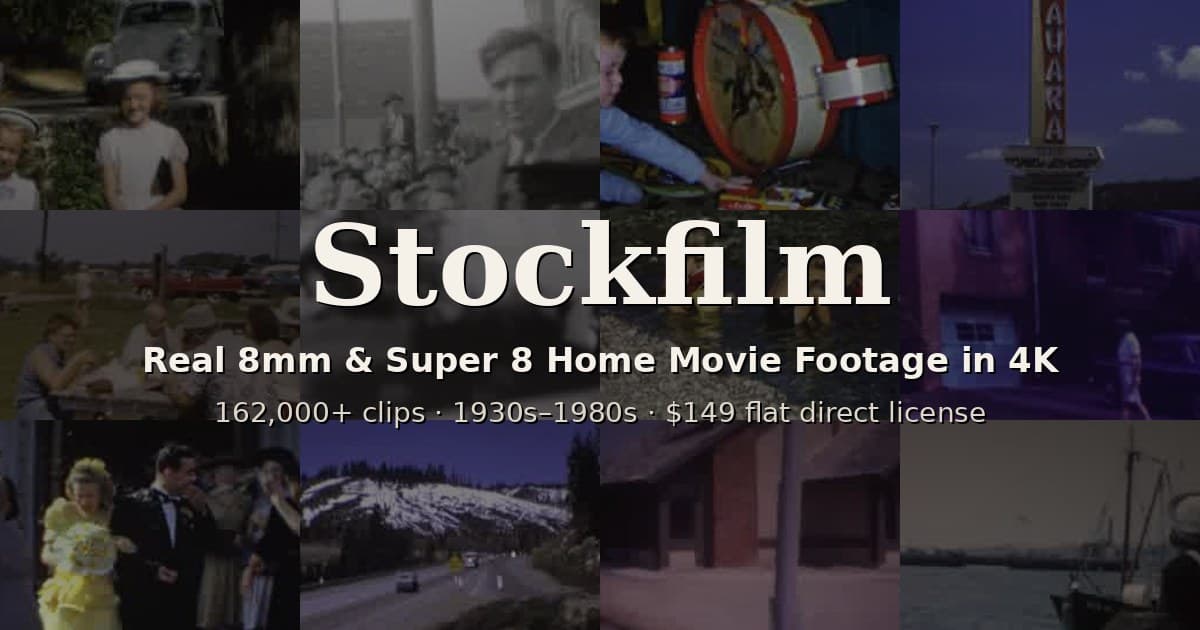
Platforms like Stockfilm maintain collections specifically curated for these requirements, focusing on preservation techniques that retain the chemical integrity necessary for broadcast authentication.
The Production Value of Material Truth
The current documentary boom examining recent subcultural history—from electronic music’s underground roots to the evolution of street art—reflects an audience hunger for stories that feel unmediated by corporate or algorithmic intervention. These productions succeed when they can demonstrate material connection to the past. A chemically-verified 8mm clip of a 1993 warehouse party carries evidentiary weight that 4K AI-upscaled reconstruction cannot match, regardless of resolution differences.
For editors and post-production supervisors, working with authentic 8mm footage also solves practical workflow problems. The footage’s inherent limitations—fixed frame rates, specific color temperature shifts, organic grain patterns—provide natural visual boundaries that prevent the "uncanny valley" effect sometimes produced when AI-enhanced footage attempts to mimic analog aesthetics. In an era where scammers deploy deepfake technology with increasing sophistication, the organic irregularities of chemical film serve as a trust signal to increasingly skeptical audiences.
FAQ
How can production teams verify that 8mm archival footage is authentic and not AI-generated?
Authentic 8mm footage exhibits specific chemical characteristics that current AI cannot replicate, including organic grain structures, halation effects around light sources, and emulsion dye patterns specific to manufacturers like Kodachrome or Ektachrome. Reputable archival sources provide spectral analysis or high-resolution scan data that reveal these material signatures. Unlike digital files, chemically-preserved film also shows natural dust, scratches, and splice marks that follow physical laws rather than algorithmic patterns.
Why is footage from the 1980s and 1990s considered particularly "at risk" for documentary production?
This period occupies the Analog Gap: after mainstream institutional archives stopped collecting everyday cultural documentation, but before digital cameras and smartphones created ubiquitous capture. Subcultural movements flourished during this window with minimal professional documentation, making them susceptible to both archival scarcity and AI-generated "filler" that attempts to reconstruct missing scenes. Unlike earlier eras that enjoy robust newsreel archives, or later periods with digital abundance, this recent history requires active recovery of amateur chemical film.
What distinguishes chemically-verified 8mm from general "found footage"?
Found footage typically refers to discovered material of uncertain provenance, often transferred through multiple generations of analog and digital formats that degrade authentication markers. Chemically-verified 8mm has been maintained on original stock or first-generation masters, with documentation confirming storage conditions, chemical stability, and unbroken chain of custody. This verification allows the footage to satisfy broadcast legal requirements and fact-checking protocols that increasingly reject material with ambiguous sourcing, particularly following recent high-profile misrepresentation incidents involving misdated archival clips.
Conclusion
The documentary landscape is recalibrating around material authenticity. As AI-generated content becomes indistinguishable from reality and misinformation campaigns exploit archival ambiguity, the chemical specificity of 8mm film offers something increasingly rare: proof of presence. For stories about communities that built their identities on being present—really, physically, chemically present—in specific moments of cultural ferment, this proof becomes the narrative itself. The Analog Gap closes only when we acknowledge that some truths require not just pixels, but physical substance.