
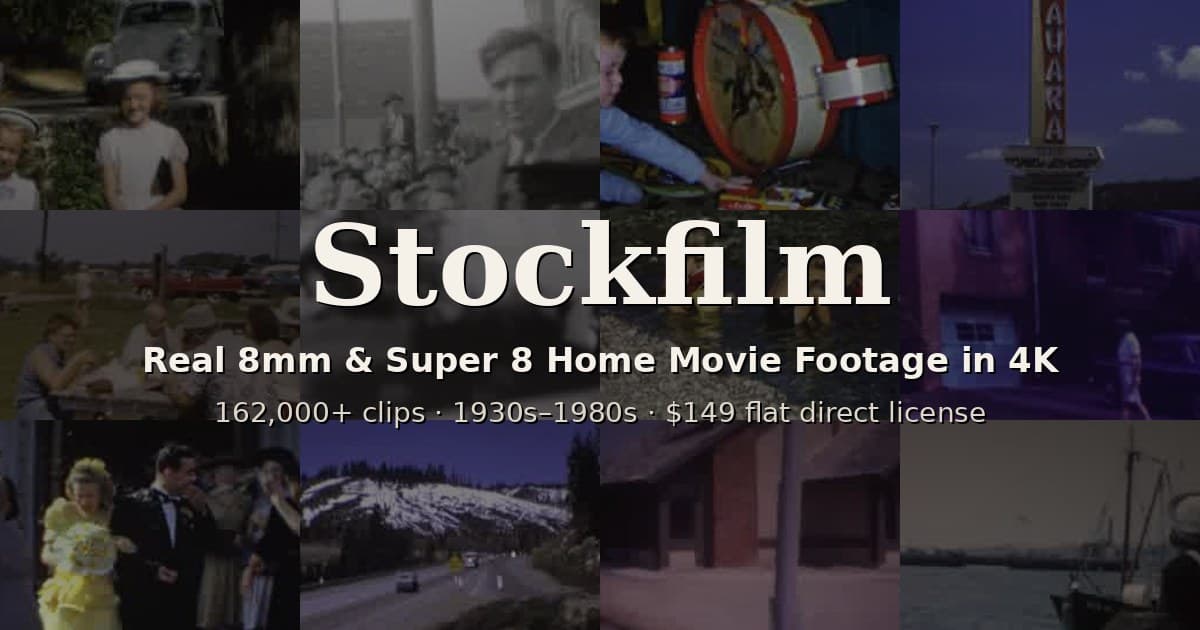
When documentary preservationists launched urgent digitization initiatives in Ghana’s archives last year, they highlighted a temporal paradox facing contemporary filmmakers: the simultaneous deterioration of physical heritage and the rise of synthetic media threatening to replace it. Across formerly colonized regions, the visual record of decolonization, early independence, and cultural transformation exists primarily on small-gauge celluloid—materials now entering terminal chemical decay while generative AI offers instant, risk-free "historical" imagery.
This convergence creates an ethical crisis for documentary producers. The choice between digitally reconstructing missing historical moments and accepting narrative silence presents a false binary. Chemically-verified 8mm and Super 8 footage—specifically amateur film shot outside colonial administrative channels—offers a third path: material testimony that carries physical authentication markers impossible to algorithmically generate.
The Preservation Emergency and the Colonial Record
Structural inequalities in historical preservation have created a lopsided archival landscape. Colonial institutions systematically documented extractive industries, administrative ceremonies, and anthropological subjects while neglecting urban development, domestic life, and internal community perspectives. Consequently, the visual history of post-colonial transition—1960s independence celebrations, 1970s urban migration patterns, 1980s economic adjustments—survives primarily in amateur formats rather than institutional collections.
These materials face immediate chemical threats distinct from professional studio negatives. Amateur reels stored in tropical climates frequently exhibit advanced vinegar syndrome (acetate decay), mold colonization, and emulsion liquefaction. Unlike digital files, which risk obsolescence but not molecular deterioration, celluloid suffering from triacetate hydrolysis releases acetic acid that accelerates its own destruction. For documentary teams, the window for accessing primary visual materials from the 1960s through the 1980s narrows with each humid season, creating production timelines constrained by chemical realities rather than editorial schedules.
Synthetic Convenience vs. Material Accountability
The documentary tradition of fictional archival construction—exemplified by strategies that create faux-historical footage to represent deliberate historical erasure—operates under strict ethical protocols. These methodologies signal their artificiality to audiences, functioning as meta-commentary on absence rather than claims to evidentiary status.
Generative AI disrupts this transparency. When documentary producers encounter gaps in the historical record—missing documentation of specific neighborhoods, absent coverage of cultural practices, incomplete visual records of displacement—the technical capacity to synthesize "plausible" footage introduces new colonial risks. AI systems trained predominantly on Western visual archives impose algorithmic assumptions about composition, lighting, and subject behavior onto Global South histories. The result risks what archivists term "digital neocolonialism": the replacement of locally-produced visual culture with statistically-generated approximations derived from imperial image banks.
Recent authentication failures involving synthetic historical footage demonstrate how synthetic media corrodes the evidentiary foundations of non-fiction storytelling. For post-colonial documentaries specifically, algorithmic reconstruction replicates the colonial gaze by substituting external imagination for internal documentation.
The Chemical Index of Historical Authenticity
Unlike digital files or AI generations, analog 8mm film carries material fingerprints that resist fabrication while providing archaeological context:
- Edge code chronology: Manufacturer edge codes stamped during production provide absolute temporal markers. Kodak's edge code system changed annually between 1960-1980, creating a chemical dating mechanism that cannot be retroactively altered without physical destruction of the emulsion.
- Dye coupler signatures: Color reversal stocks employed specific dye coupler chemistry (E-4, ME-4, etc.) that produced distinct spectral responses and color casts. These chemical signatures create saturation curves and chromatic aberrations that differ fundamentally from digital color grading or neural network generation.
- Mechanical stress markers: Authentic amateur footage exhibits gate weave, pressure plate scratches, and sprocket hole deformation that indicate actual mechanical passage through camera and projector mechanisms. These physical signatures follow Newtonian physics and entropy patterns that AI systems struggle to simulate convincingly at microscopic inspection.
- Optical halation patterns: The celluloid substrate and anti-halation backing layers of period-specific stocks create characteristic bloom effects around high-contrast light sources. These phenomena result from the physical interaction of photons with silver halide crystals and gelatin emulsion—quantum mechanical effects that post-production plugins approximate but rarely replicate with chemical accuracy.
- Base material stratification: The transition from acetate to polyester film bases during the 1970s-1980s creates distinct physical properties including flexibility, shrinkage rates, and spectral transmission characteristics that serve as material timestamps.
Decolonizing the Frame: The Amateur Optical Unconscious
Official colonial archives typically employ what cinematographers call the "administrative gaze": static wide shots emphasizing taxonomic clarity, subjects framed for identification rather than narrative, and lighting schemas optimized for bureaucratic documentation. Amateur 8mm footage—shot by local families, church groups, students, and community organizations—inverts these conventions through the "optical unconscious" of domestic recording.
A reel documenting a 1972 independence celebration in Accra or a 1968 neighborhood gathering in Dar es Salaam carries compositional choices reflecting internal community hierarchies rather than external observation. The focal lengths chosen, the temporal pacing of pans and tilts, and the spatial relationships between camera and subject reveal social proximies that colonial documentation deliberately maintained. These materials function as primary ethnographic texts, capturing architectural details, fashion transitions, and environmental conditions with the archaeological specificity of accidental documentation.
For documentary editors, such footage provides not merely illustration but evidentiary foundation. When cutting sequences addressing urban transformation or cultural continuity, period-appropriate 8mm offers temporal anchoring that aligns with the physics and chemistry of the historical moment rather than contemporary aesthetic assumptions.
Rigorous Protocols for Ethical Licensing
Navigating the tension between historical gaps and material authenticity requires rigorous archival protocols. When sourcing small-gauge footage for post-colonial documentary projects, producers should implement verification frameworks:
- Provenance documentation: Require chain-of-custody records establishing geographic origin and collection history. For 8mm materials, this includes processing lab marks, date codes on film leaders, and chemical analysis reports verifying stock manufacture dates.
- Technical transfer standards: Evaluate whether digitization captured the full dynamic range and dye layer information of the original reversal stock. Overly aggressive digital "restoration" that eliminates grain structure or alters color timing strips materials of their temporal specificity and chemical signatures.
- Community representation rights: Verify that licensing agreements address depictions of recognizable individuals in non-public settings, particularly when sourcing amateur footage from private collections. Ethical archival practice requires distinguishing between legal ownership and community consent regarding cultural representation.
- Material condition assessment: Request documentation regarding vinegar syndrome progression, shrinkage percentages, and emulsion stability. These physical conditions, while appearing as technical limitations, actually serve as authentication markers proving the footage’s analog origins.
Specialized archival providers maintaining climate-controlled vaults and chemical testing laboratories can provide the verification layers necessary for these workflows. The key distinction lies in selecting sources that prioritize material preservation over algorithmic convenience—archives that treat footage as physical evidence requiring conservation rather than content requiring upscaling.
Frequently Asked Questions
How does chemically-verified 8mm footage differ from AI-generated historical recreations in documentary contexts?
Chemically-verified 8mm footage captures light through analog photochemistry, creating physical records containing edge codes, dye coupler signatures, and mechanical wear patterns that serve as temporal authentication. AI-generated recreations simulate imagery based on statistical training data, producing visuals that lack material connection to the historical moment. For post-colonial documentary ethics, this distinction proves crucial because synthetic media imposes algorithmic assumptions derived from potentially colonial image banks, whereas archival footage preserves the actual visual culture and material conditions of the period.
Why are documentary teams specifically seeking amateur 8mm footage over official archival sources for post-colonial histories?
Official archives from colonial and immediate post-colonial eras predominantly reflect administrative, extractive, or exoticizing perspectives that served imperial governance. Amateur 8mm footage—shot by local residents, families, and community members—captures domestic life, cultural practices, and urban environments from internal viewpoints. As these materials deteriorate, documentary teams recognize them as essential primary sources for representing histories that institutional archives deliberately excluded or marginalized.
What chemical verification methods confirm the authenticity of archival 8mm footage?
Authentication relies on multiple material analyses: examination of manufacturer edge codes that changed annually and cannot be altered without emulsion destruction; spectral analysis of dye coupler chemistry specific to decades; measurement of base material shrinkage rates indicating acetate vs. polyester composition; and microscopic inspection for mechanical wear patterns (gate weave, scratches) indicating actual camera and projector passage. These chemical and physical markers create a composite authentication profile impossible to replicate through digital generation or reconstruction.
How should producers address the ethical complexities of licensing amateur footage from the Global South?
Producers should prioritize sources providing detailed provenance documentation while respecting community representation rights. This includes verifying that collectors obtained materials through ethical means, ensuring licensing agreements account for depictions of cultural practices and recognizable individuals, and distinguishing between legal ownership and community consent. The urgency of preservation in tropical climates must not override ethical collection practices or fair compensation frameworks for source communities whose heritage appears in private archival collections.
Conclusion
The preservation crisis confronting Ghana’s archives represents merely the visible apex of a global emergency affecting post-colonial visual heritage. As synthetic media capabilities expand and historical gaps tempt algorithmic solutions, documentary producers face defining ethical choices. Chemically-verified 8mm footage offers something that digitization emergencies and AI generation cannot replicate: material testimony that existed in real time, carrying the chemical signatures, optical physics, and mechanical imperfections of actual historical moments.
In an era where digital fabrication threatens to colonize historical representation anew, the physical chemistry of analog film provides the ethical foundation that documentary audiences—and the communities whose histories hang in the balance—require. The authentication lies not in the image’s clarity, but in its material scars.