
In the same week that headlines announced an AI-resurrected Val Kilmer would headline an upcoming film, other news outlets tracked a more somber technological deployment: Israeli Prime Minister Benjamin Netanyahu posting video proof of life to counter AI-generated death rumors. These concurrent trends—the synthetic resurrection of performers and the desperate deployment of video to prove reality—illustrate a widening fault line in contemporary production. For documentary teams, biographical researchers, and archival licensors, the question is no longer simply "What looks good?" but rather "What constitutes evidence of a life actually lived?"
The answer, increasingly, lies not in algorithmic generation but in the chemically-fixed, photochemical reality of 8mm and Super 8 archival footage.
The Resurrection Dilemma
Hollywood’s ambivalence toward AI-generated performances has crystallized around recent projects using synthetic voice technology and digital mapping to recreate performers who cannot—or should not—be present. While these tools offer narrative continuity, they introduce a philosophical discomfort that documentary audiences, in particular, struggle to reconcile. When a viewer watches a synthetic performance, they are witnessing a digital puppetry that derives authority from the subject’s likeness while severing the causal link between the subject’s existence and the image.
This is where the Netanyahu "proof of life" phenomenon becomes instructive for producers. In an information environment where the Jerusalem Post reports that "AI is rewriting Israel's war reality" with fake missiles and fabricated deaths, the demand for media that functions as material evidence rather than plausible simulation has become acute. Documentary audiences are developing sophisticated skepticism toward anything that appears too polished, too perfectly lit, or too conveniently available. The Snopes investigation into Cesar Chavez, relying on unearthed archival footage to verify historical claims, demonstrates the opposing trajectory: audiences and platforms are gravitating toward source material that carries intrinsic evidentiary weight.
Chemical Witness vs. Digital Puppet
The distinction between AI-generated content and archival 8mm footage is not merely aesthetic; it is ontological. When a documentary incorporates chemically-processed 8mm film, it is integrating a physical record of photons that actually struck a subject’s face, silver halide crystals that reacted to specific moments in time. This photochemical chain of custody—from exposure through development to digital scanning—creates what might be called a "chemical contract" with the viewer: this moment happened, this light existed, and this person was undeniably present.
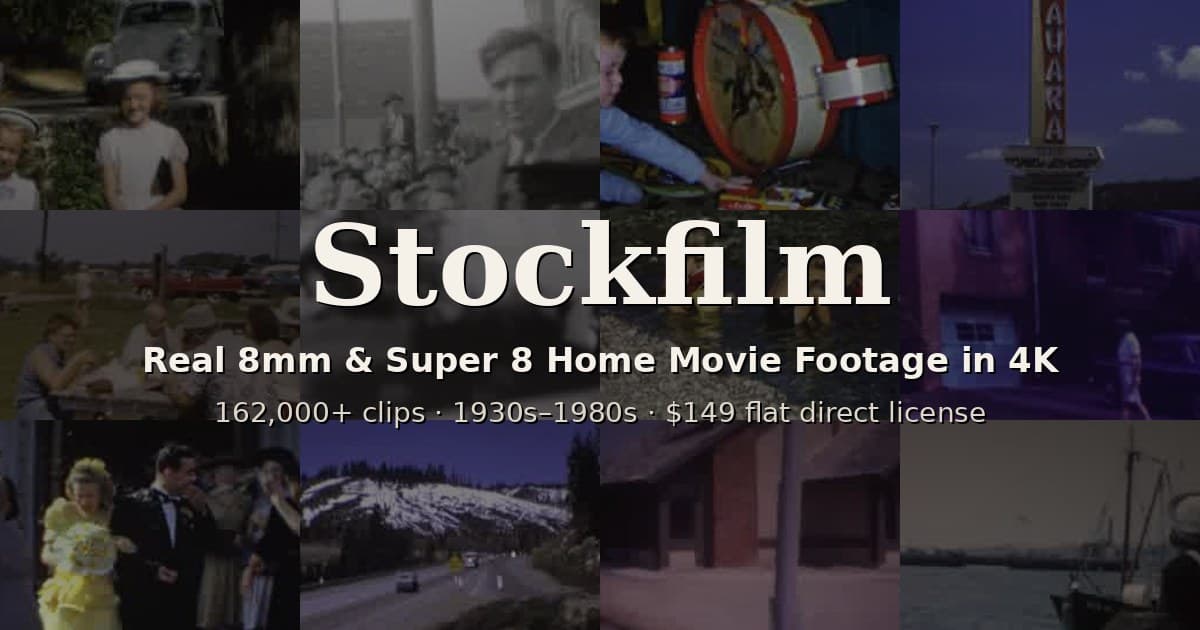
Stockfilm’s collections, like all authentic pre-digital archival holdings, maintain this physical provenance. Unlike digital video, which consists of rewritable code vulnerable to manipulation, 8mm film stock is a material artifact. The granularity, the slight gate weave, the particular quality of highlight bloom—these are not filters to be applied but forensic signatures of analog capture. For producers navigating the current crisis of synthetic media, this materiality offers something algorithms cannot: temporal certainty.
The Estate Calculus: Rights, Respect, and Revenue
For estates managing the legacy of deceased performers, musicians, or public figures, the choice between licensing archival footage and authorizing AI resurrection involves complex ethical and commercial calculations. The upcoming John Lennon archival concert film, "Power To The People," represents one path: presenting the artist as he actually existed, in his actual environment, captured by cameras that recorded his genuine physical presence. This approach respects the finality of the subject’s lived experience while maximizing the archival asset’s value.
Conversely, AI synthesis creates ongoing legal ambiguities. Performance rights, voice rights, and likeness permissions for synthetic media remain inconsistently defined across jurisdictions, creating liability for distributors. Archival footage, by contrast, operates within established licensing frameworks. When a documentary series licenses 8mm home movies, the chain of title, while requiring due diligence, follows precedents that errors and omissions insurance recognizes and courts have adjudicated.
Moreover, estates are recognizing that audiences respond differently to authentic vulnerability. The unguarded moments captured in Super 8—the missed cue, the genuine laugh, the unscripted gesture—carry emotional textures that synthetic performances, optimized for perfection, often flatten. In an era where "authenticity" has become the scarcest production value, the unpolished reality of vintage film offers competitive distinction.
A Framework for Ethical Archival Integration
Production teams assessing their media strategies for biographical or legacy projects should consider the following decision framework when weighing archival against synthetic options:
- Provenance Verification: Prioritize footage with documented chemical processing dates and chain-of-custody records. Preservation methodologies that emphasize photochemical integrity provide the verification infrastructure that digital files cannot match.
- Temporal Specificity: Use archival footage to anchor narratives in specific historical moments. The visual texture of period-accurate film stock provides temporal anchoring that AI-generated content, which often exists in a vague stylistic eternal present, fails to achieve.
- Legal Clarity: Evaluate licensing agreements for archival footage against the emerging—and often ambiguous—rights structures governing synthetic performances. Archival licenses typically offer cleaner indemnification pathways.
- Audience Trust Architecture: Consider the documentary’s position within an information ecosystem polluted by deepfakes. Chemically-verified footage functions as a trust signal, communicating to viewers that the production has invested in material reality rather than convenient simulation.
Frequently Asked Questions
How can producers verify that archival 8mm footage is authentic and not AI-generated?
Authentic 8mm footage exhibits specific material characteristics that current AI struggles to replicate consistently: photochemical grain structures that differ from digital noise, organic gate weave (subtle vertical instability), and highlight handling that follows analog film’s characteristic shoulder curves. Reputable archives provide photochemical provenance documentation, including stock manufacturer dates and processing lab records. When sourcing footage, request the original film elements or high-resolution scans that show these material signatures rather than compressed deliverables where artifacts might be obscured.
What are the cost implications of licensing archival footage versus commissioning AI synthesis?
While AI synthesis may appear cost-effective for brief clips, the total cost of ownership often favors archival licensing for documentary projects. Synthetic media requires extensive legal clearance for voice, likeness, and performance rights, often involving ongoing royalty obligations to estates. Archival footage typically involves a one-time licensing fee with defined usage parameters. Additionally, archival integration requires less post-production rendering time and computational infrastructure than high-fidelity AI generation, accelerating delivery timelines for deadline-driven productions.
How should documentarians disclose the use of archival versus synthetic media in their projects?
Transparency protocols are evolving, but best practices suggest clear delineation in end credits and, where appropriate, on-screen labels during the footage itself. When using authentic 8mm archival material, noting the source and date in lower thirds reinforces the footage’s evidentiary value. For hybrid projects that use both archival and synthetic elements, maintaining distinct visual grammars—perhaps reserving specific aspect ratios or color treatments for verified archival material—helps audiences navigate the boundary between recorded reality and constructed narrative.
The Unrepeatable Moment
As the boundaries between recorded reality and algorithmic generation continue to blur, the value of the irreplaceable take—the moment when light actually touched film in the presence of a now-absent subject—will only appreciate. For producers, archivists, and documentary teams, authentic 8mm footage represents not nostalgia but infrastructure: a verified, licensable, and ethically sound resource for telling true stories in an age of synthetic uncertainty. The chemical evidence remains, waiting in the vault, proof that certain moments were undeniably real.