
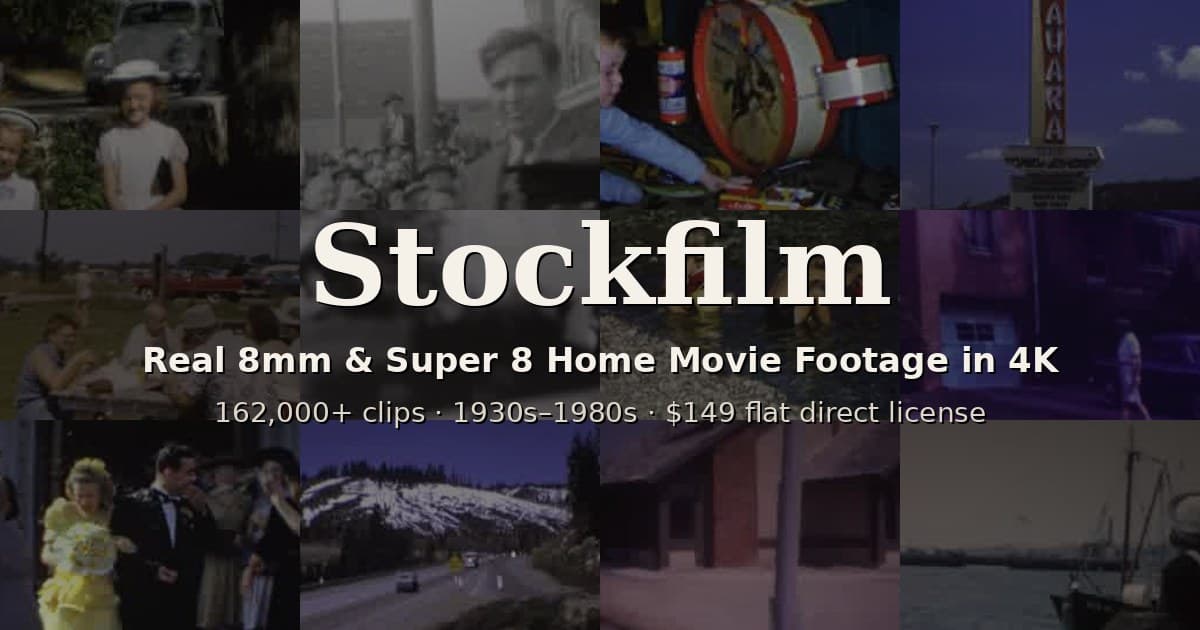
The current production landscape presents a peculiar paradox. On the same April morning that newsrooms scrambled to verify whether footage of Iran’s Supreme Leader was algorithmically generated or chemically captured, Taylor Swift’s production team released a music video built entirely around archival 8mm clips of Elizabeth Taylor. These two moments—one a crisis of authentication, the other a deliberate creative choice—illustrate the emerging bifurcation in 2026 video production workflows.
For producers, editors, and documentary teams, the question is no longer simply whether to use archival footage for nostalgic effect. The pressing concern is workflow efficiency in an environment where synthetic media creation is instantaneous, but verification protocols are becoming production bottlenecks. The strategic integration of chemically-processed 8mm and Super 8 archives offers a material solution to this digital friction.
The Hidden Cost of Synthetic Media
The proliferation of AI video generation tools has undeniably expanded creative possibilities, yet it has introduced a downstream tax that many production budgets fail to anticipate: the verification burden. When a documentary sequence or brand film relies on synthetically generated imagery, every frame carries an implicit liability. Teams must allocate resources to authentication protocols, platform compliance checks, and audience skepticism management.
This is not merely a concern for newsrooms covering geopolitical events. Even in entertainment contexts, the cognitive load of questioning a clip’s provenance interrupts narrative immersion. When viewers pause to wonder whether a historical recreation was rendered by neural networks or recorded by photons striking celluloid, the storytelling spell breaks.
Chemically-captured 8mm footage sidesteps this verification labyrinth entirely. The physical properties of silver halide crystals responding to specific light waves at specific moments in time create what preservationists call "non-repudiable temporal specificity." Unlike synthetic media, which generates statistically probable imagery, archival film captures irreducible historical moments. For production teams, this translates to assets that move through post-production without the friction of authenticity debates.
Material Specificity and the Organic Aesthetic
Current video production trends indicate a marked shift toward what industry observers term "organic imperfection"—the deliberate embrace of texture, grain, and optical irregularity that signals human-scale production values. This aligns with broader cultural movements visible in the restoration of historic Havana architecture or the meticulous reconstruction of classic confectionery recipes, where material heritage carries premium value.
Authentic 8mm footage delivers this aesthetic inherently, not through algorithmic approximation but through physical optics. The characteristics that make chemically-captured film distinct from digital sensors or generative models include:
- Non-repeating grain structures that respond to emulsion chemistry rather than mathematical patterns
- Spectral highlight behavior that obeys the actual physics of light refracting through vintage lenses
- Temporal artifacts such as gate weave and flicker that signal mechanical movement through time
- Depth of field characteristics unique to small-gauge optics and chemical recording mediums
These qualities cannot be synthesized because they emerge from physical processes—light interacting with chemistry, mechanical irregularities in camera transport systems, the specific humidity and temperature of the moment of exposure. For productions seeking the visual language of material authenticity described in recent archive methodology discussions, sourcing original footage eliminates the uncanny valley effect that plagues AI-generated "vintage" aesthetics.
Workflow Integration in Modern Post-Production
The practical advantages of integrating 8mm archives extend beyond aesthetics into technical workflow efficiencies. Modern 4K and 8K scanning technologies have transformed small-gauge film into resolution-independent assets suitable for contemporary delivery standards. When properly preserved and digitized—processes detailed in our preservation protocols—these archives offer unique post-production advantages.
Color grading chemic ally-captured footage requires fundamentally different approaches than digital or synthetic material. The color information exists in dye layers and silver density rather than RGB values, providing colorists with organic latitude that responds to adjustment curves in physically intuitive ways. This material behavior allows for faster grading sessions, as the footage naturally falls into complementary relationships with modern digital capture when intercut.
Furthermore, archival footage provides "pre-authenticated" b-roll for documentary projects. In an era where platforms increasingly flag or label potentially synthetic content, sourcing from verified chemical origins streamlines distribution workflows. Production teams using authenticated archival material avoid the delays associated with platform verification requests or audience fact-checking initiatives.
Strategic Sourcing: When Archives Outperform Generation
Determining when to license archival footage versus commissioning new capture or generating synthetic imagery requires evaluating the specific demands of the narrative. Archival 8mm and Super 8 sources prove particularly valuable in the following contexts:
- Cross-generational storytelling requiring visual continuity between eras without the expense of period-accurate production design
- Pre-digital historical contexts where the texture of the medium itself serves as temporal shorthand
- Sequences requiring specific optical phenomena such as authentic lens flare, chemical highlight blooming, or emulsion-based contrast curves
- High-volume content pipelines where the per-second cost of authentic archival licensing proves more economical than physical production or synthetic generation with subsequent verification protocols
Documentary series producers have found particular value in this approach, as evidenced by recent case studies where archival integration reduced production schedules while increasing viewer trust metrics. The footage serves simultaneously as visual content and as evidentiary foundation, eliminating the need for separate authentication graphics or disclaimers.
Frequently Asked Questions
How does 8mm footage integrate with 4K/8K delivery requirements?
Modern scanning technologies capture 8mm and Super 8 film at resolutions exceeding 4K, extracting the full information density embedded in the chemical emulsion. Because film grain is organic and non-repeating, it scales differently than digital pixels, often appearing sharper and more detailed than native digital footage of equivalent resolution. Professional preservation workflows ensure these scans provide clean, artifact-free masters suitable for high-resolution delivery.
What distinguishes authentic 8mm grain from AI-generated vintage filters?
Algorithmic filters apply mathematical noise patterns that repeat at regular intervals and respond uniformly to color adjustments. Authentic chemical grain consists of randomly distributed silver halide crystals that vary in density based on local exposure, chemistry temperature, and development time. When color-graded, authentic grain shifts in chroma and luminance in complex, non-uniform ways that signal physical materiality. The human visual system detects this difference subconsciously, creating the "comfort" of recognized reality versus the unease of synthetic approximation.
Do licensing workflows differ for archival versus generated content?
Archival licensing follows established chain-of-custody protocols that provide clear rights clearance, often simplifying E&O insurance processes. Synthetic media, conversely, enters complex emerging territory regarding training data rights and output ownership. Licensed archival footage provides definitive provenance documentation, reducing legal review time and providing production teams with indemnification against future rights claims. This administrative efficiency represents a significant hidden value in archival sourcing.
Conclusion
The 2026 production landscape rewards material intelligence. As the costs of synthetic verification continue to accumulate—whether measured in fact-checking delays, platform compliance friction, or audience skepticism—the strategic value of chemically-captured archives becomes operational rather than merely nostalgic. For teams navigating the tension between creative ambition and production efficiency, integrating authentic 8mm footage offers a rare convergence of aesthetic distinction and workflow simplicity. In an industry increasingly concerned with what is real, the decision to work with irreducibly physical media becomes not just a creative choice, but a production strategy.