
# The Pre-Synthetic Archive: Tactical Sourcing for the 2026 World Cup Documentary Cycle
The announcement that YouTube will serve as FIFA’s preferred platform for 2026 World Cup coverage signals more than a shift in broadcast rights. It marks the convergence of two powerful forces reshaping documentary production: an insatiable appetite for historical context surrounding global mega-events, and a deepening crisis of confidence in moving images themselves. When political figures must issue “proof of life” videos to counter AI-generated death rumors—only to have those videos immediately suspected as synthetic—the fabric of visual trust has fundamentally frayed. For producers preparing to document the first World Cup hosted across three North American nations, this creates a unique procurement challenge. The solution increasingly lies not in algorithmic generation, but in the chemical emulsion of pre-digital 8mm and Super 8 film.
The Verification Economy Meets Mega-Event Production
The 2026 tournament represents an inflection point for sports documentary. With 48 teams competing across 104 matches in the United States, Canada, and Mexico, the content demands will dwarf previous cycles. Broadcasters and streaming platforms will require not merely highlight reels, but deep cultural context—footage illustrating the evolution of the sport’s North American presence, the grassroots fan cultures of the 1970s and 1980s, and the informal moments that professional broadcast cameras never captured.
Simultaneously, audiences have developed what media literacy scholars term “synthetic suspicion.” The recent viral dissemination of AI-generated political content, followed by frantic attempts to verify reality through video, has trained viewers to question the provenance of any digital file. For documentary editors, this creates a liability: even authentic contemporary footage risks scrutiny, while AI-generated “historical” B-roll threatens to contaminate editorial integrity. The production imperative has shifted from mere aesthetic preference to tactical necessity. Footage that predates the synthetic era carries an evidentiary weight that digitally-born material cannot replicate.
The Material Logic of Analog B-Roll
Pre-digital 8mm film offers distinct production advantages that extend beyond nostalgia. The physical characteristics of chemically-processed celluloid—grain structure, halation, registration instability, and the specific latitude of vintage color reversal stocks—create visual signatures that current generative models struggle to replicate convincingly at scale. More importantly, these analog artifacts serve as immediate visual shorthand for authenticity in an era of digital manipulation.
For producers licensing archival material for the 2026 documentary cycle, this translates into practical workflow efficiencies:
- Immutable Temporal Markers: Chemical processing dates and film stock manufacturing timelines provide irrefutable temporal boundaries. When sourcing footage of 1970s youth soccer leagues or 1980s suburban World Cup viewing parties, the physical properties of the film serve as their own metadata.
- The “Fan’s Eye” Perspective: Unlike 16mm newsreel or 35mm broadcast material, 8mm was primarily a consumer format. It captures the unguarded periphery of major events—parking lot gatherings, living room reactions, youth league practices—offering the cultural texture that professional crews missed.
- Rights Clarity: Pre-digital amateur footage, when properly cleared through specialized archives, often carries cleaner chains of title than contemporary user-generated content, which may involve platform rights complexities and AI-training opt-out disputes.
- Editorial Breathing Room: In an environment where every digital clip risks accusations of manipulation, analog grain provides visual “cover” for authenticity. It signals to audiences that the footage predates the synthetic era without requiring explanatory captions that disrupt narrative flow.
The Home Movie as Historical Infrastructure
The value proposition extends into the realm of community memory. Recent trends in archival programming—from St. Paul’s “Archival Footage Bingo” events to the UCLA Film & Television Archive’s public screenings—demonstrate growing audience appetite for regional, non-institutional perspectives on history. For World Cup documentaries, this translates into demand for footage that captures the tournament’s infiltration of everyday American life during the sport’s early North American growth periods.
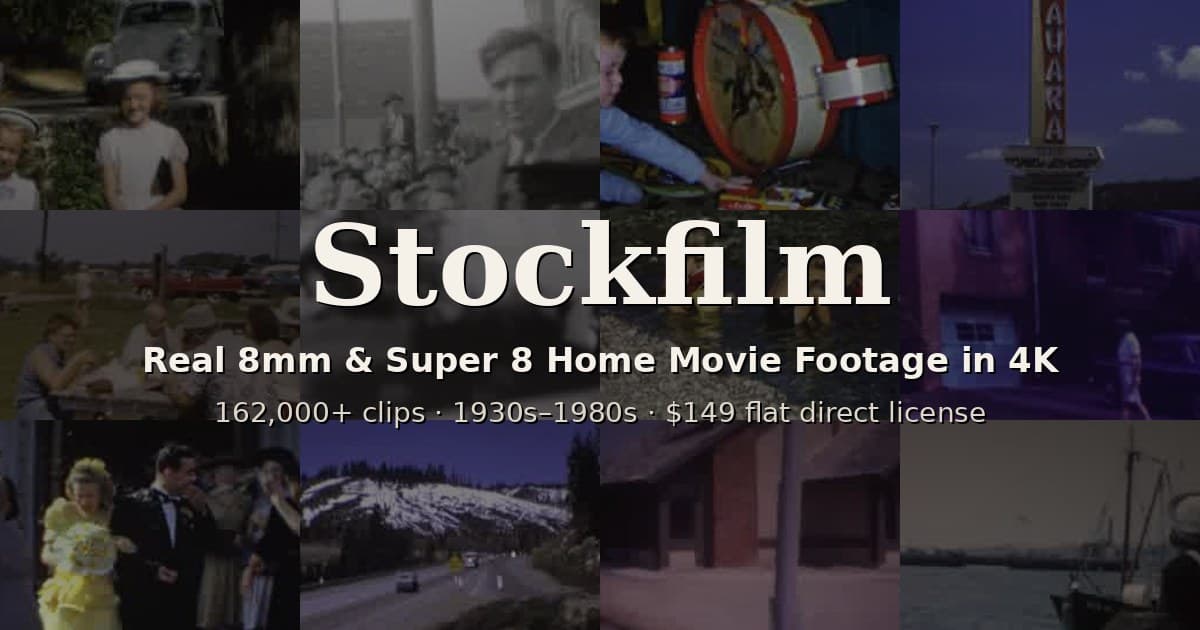
Stockfilm’s collections of 8mm home movies provide exactly this substrate: the backyard kickabouts of the 1970s, the early MLS-era fan experiences, and the multicultural community leagues that preceded professional soccer’s commercial boom. These images serve not merely as B-roll filler, but as evidentiary foundations for narratives about the sport’s cultural integration.
Licensing for the YouTube Ecosystem
YouTube’s role as FIFA’s preferred platform introduces specific archival requirements. The platform’s Content ID systems and global distribution network demand impeccable provenance and cleared music rights—a particular challenge when sourcing historical footage that may contain incidental radio or television audio. Archival houses that specialize in chemically-preserved 8mm provide the necessary documentation chains for global digital distribution, ensuring that documentary series won’t face regional takedowns due to rights ambiguities.
Furthermore, the platform’s algorithmic preference for “authentic” engagement metrics suggests that content demonstrating verified historical depth may receive preferential treatment over synthetic or shallowly-sourced material. As documentary teams prepare content libraries for the 2026 cycle, investing in pre-cleared, 4K-scanned analog archives represents risk mitigation against both legal challenges and audience skepticism.
Frequently Asked Questions
Can’t AI simply generate convincing vintage sports footage, making analog archives obsolete?
While generative models can approximate film grain, they currently struggle with the chemical randomness of organic emulsion—specifically the way highlight halation and registration weave behave in physically processed film. More critically, AI cannot manufacture provenance. Documentaries relying on synthetic “vintage” footage face existential credibility risks, particularly when covering subjects as culturally significant as the World Cup. The physical artifact remains the only vector for certain temporal truth claims.
Why prioritize 8mm over professional 16mm or 35mm broadcast archives for sports documentaries?
Professional formats captured the official narrative; 8mm captured the cultural substrate. For the 2026 tournament specifically, which emphasizes cross-border cultural exchange, the amateur footage of 1970s and 1980s community soccer provides essential context for how the sport permeated North American life before the MLS era. These consumer formats offer the informal, gender-diverse, and ethnically varied perspectives often absent from professional sports broadcasting of those decades.
How does analog archival sourcing fit into tight documentary production schedules?
Pre-scanned, cataloged 4K archival libraries eliminate the laboratory variables that once slowed analog workflows. When producers source from repositories that handle both preservation and rights clearance, 8mm footage integrates into modern post-production pipelines as seamlessly as digital files—with the added benefit of built-in authenticity verification that satisfies increasingly rigorous fact-checking protocols at major streaming platforms.
Conclusion
The 2026 World Cup will test not merely athletic competition, but the limits of visual credibility in documentary storytelling. As platforms prepare for unprecedented coverage volumes and audiences sharpen their skepticism of digital images, the tactical advantage shifts toward material that cannot be synthesized. Pre-digital 8mm archival footage offers more than aesthetic texture; it provides the chemical certainty required to anchor historical narratives in an era of synthetic doubt. For producers navigating the intersection of massive content demand and fragile audience trust, the pre-synthetic archive is becoming essential production infrastructure.