
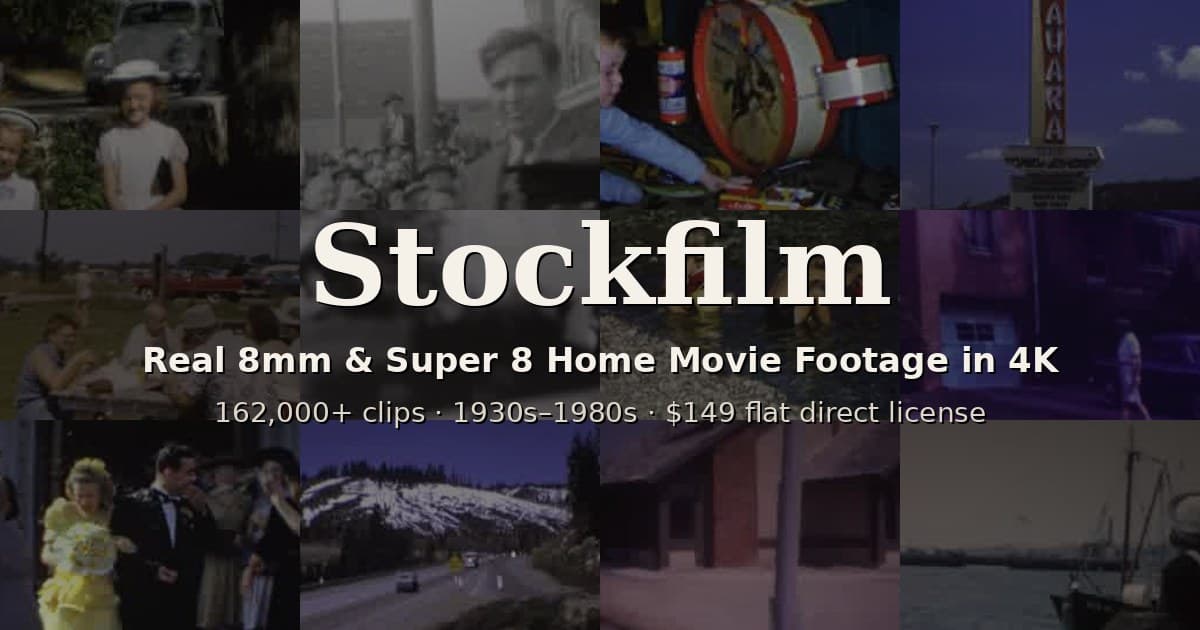
In the opening sequences of the recent David Attenborough-narrated conservation documentary, viewers are presented with lush montages of habitats that have since vanished—images that establish an emotional and ecological baseline against which present devastation is measured. Meanwhile, restoration crews in Old Havana are discovering that their most valuable references for architectural fidelity aren't technical blueprints, but the accidental backgrounds of vacation films shot decades ago.
These seemingly disparate productions share a common production infrastructure: vintage 8mm and Super 8 archival footage. As documentary teams, heritage marketers, and urban planners confront an era of accelerated environmental and cultural change, they are increasingly sourcing pre-digital amateur film not merely for aesthetic texture, but as forensic baselines of a world that no longer exists.
The Baseline Problem
Modern documentary production faces a peculiar temporal challenge. To tell stories of glacier retreat, coastal erosion, urban gentrification, or post-conflict reconstruction, filmmakers require visual evidence of "before." Yet the digital revolution coincided precisely with the acceleration of these transformations. High-definition digital capture became ubiquitous around 2008—meaning the critical decades of late-20th-century change were documented primarily on chemically processed film, or not at all.
For producers working on climate impact narratives or urban heritage campaigns, this creates a sourcing gap. Satellite imagery provides data, but not the human-scale texture that makes transformation emotionally legible to audiences. Early digital video often lacks the latitude and color stability necessary for seamless archival integration. This is where the chemical integrity of 8mm film becomes a production asset rather than merely a stylistic choice.
The Accidental Documentarians
The value proposition of vintage 8mm in transformation storytelling lies in its unintentionality. Unlike contemporary location scouting footage shot with editorial intent, amateur home movies from the 1960s through 1990s captured environments incidentally—the mountain vista behind a birthday party, the streetscape visible through a hotel window, the coastline during a family picnic.
This unconscious documentation creates what archival researchers call "baseline purity." Because these films weren't shot to prove a point about environmental degradation or urban change, they lack the compositional bias of advocacy footage. The glacier isn't framed to look majestic; the neighborhood isn't shot to appear quaint. The camera simply recorded what was there, providing documentary teams with neutral visual evidence that supports comparative editing without editorial manipulation.
Three Production Categories Driving Demand
The licensing patterns for transformation narratives tend to cluster around three specific production categories, each with distinct technical and rights-clearance requirements:
Environmental Impact Narratives
Climate change documentaries increasingly require visual proof of ecological states that predate modern monitoring. Productions covering glacial retreat, coral bleaching, or deforestation use vintage 8mm to establish the "human memory" of these landscapes. The footage serves dual purposes: providing the visual "before" state, and establishing the emotional stakes through the evident innocence of the original capture—the family picnic in a forest that has since burned, the ski vacation at a glacier that has vanished.
Urban Memory and Architectural Heritage
As cities worldwide engage in preservation and renewal projects—from Havana's restoration districts to post-industrial adaptive reuse in the American Rust Belt—planners and documentarians require reference material for architectural authenticity. 8mm archives captured by tourists and residents provide street-level documentation of building facades, signage, and neighborhood textures that predate modern development. For heritage marketers, this footage offers the material specificity necessary for "then and now" campaigns that resonate with local audiences.
Post-Conflict and Post-Disaster Reconstruction
Documentary teams covering reconstruction in regions affected by war or natural disaster face unique verification challenges. Vintage footage establishes not just physical baselines, but cultural continuity—evidence of communities, rituals, and daily life that persisted before disruption. This application requires particular attention to archive methodology and chain-of-custody documentation, as the footage often serves as cultural heritage preservation as much as editorial content.
The Verification Layer
While much recent industry discussion has focused on AI-generated synthetic media as the primary authenticity threat, transformation documentaries face a parallel verification challenge: temporal misattribution. Using footage from 1992 to illustrate 1976 conditions undermines the credibility of environmental claims.
Chemically-processed 8mm film provides inherent temporal markers through stock emulsion characteristics, edge codes, and color shift patterns that digital restoration specialists can authenticate. For productions making specific claims about environmental or cultural change—"this glacier in 1970 versus 2025"—these material verifications function as liability protection. Unlike digital files with mutable metadata, film carries its temporal fingerprint in its physical chemistry.
Sourcing Strategies for Transformative Narratives
Production teams seeking baseline footage for transformation stories should consider the following practical framework:
- Prioritize incident over intent: Search for footage where the environment appears as background rather than subject. A family walking through a plaza provides more authentic architectural documentation than a deliberately framed "scenic shot" that may have been composed to exclude modern intrusions or commercial signage.
- Consider the seasonal archive: For environmental narratives, ensure your source collection includes footage shot during relevant seasons. A winter glacier shot provides different baseline value than summer documentation, and foliage conditions can help narrow temporal windows for urban footage.
- Evaluate the scan quality for comparative use: When licensing for "then and now" sequences, verify that the archival scan resolution and color space can withstand direct comparison with modern 4K capture without requiring destructive digital manipulation that might compromise authenticity claims.
- Secure exhibition rights for educational distribution: Many transformation documentaries have extended lives in museum installations, educational licensing, and heritage site exhibitions. Clarifying these rights during initial licensing prevents downstream clearance issues when the footage becomes embedded in permanent institutional displays.
Frequently Asked Questions
How do documentary producers verify the exact date and location of vintage 8mm footage used for environmental baselines?
Verification relies on a combination of material analysis and contextual research. Film stock manufacturing dates can be determined through edge codes and emulsion characteristics, narrowing windows to specific years. For location verification, producers often cross-reference architectural details, vehicle models, and vegetation visible in the footage with historical city directories, local newspaper archives, and geological surveys. Stockfilm's methodology includes provenance documentation where available, though producers typically augment this with independent research for specific environmental claims.
Can 8mm footage shot by amateurs legally be used in commercial environmental campaigns?
Yes, provided the licensing chain is clear. Commercial use requires explicit rights clearance from the rights holder—typically the original shooter or their estate. For footage acquired through archival aggregators, ensure your license specifically covers commercial exhibition, derivative works, and the specific media (broadcast, streaming, out-of-home) required for your campaign. Environmental documentaries that receive corporate sponsorship or branded content integration face the same clearance requirements as traditional advertising.
What technical challenges arise when cutting vintage 8mm with modern digital footage in comparative sequences?
The primary challenge is matching color science and motion cadence. Modern digital capture at 24p or 60p has different temporal characteristics than the 18fps standard of Super 8. Successful comparative edits often embrace the material difference rather than attempting to smooth it away—using split-screens or direct cuts that acknowledge the temporal distance between "then" and "now." Color grading should respect the film's organic color shift (common in Kodachrome and Ektachrome stocks) rather than forcing it to match modern digital colorimetry, as these shifts often serve as implicit authenticity markers for audiences.
Conclusion
As the pace of environmental and cultural transformation accelerates, the role of vintage 8mm footage shifts from decorative nostalgia to evidentiary necessity. The accidental archives captured by mid-century tourists and families have become the baseline data for understanding what we have lost, what we are preserving, and what we might yet reclaim. For documentary teams navigating the complex production demands of transformation storytelling, these chemical records offer something that neither digital reconstruction nor AI generation can replicate: the unvarnished testimony of a moment that can never be revisited, only responsibly preserved.