
When Fox News aired three-year-old footage of a dignified transfer ceremony—showing a hatless presidential figure from a previous administration—while covering current events this March, the network’s subsequent apology highlighted more than a production error. It revealed a fundamental vulnerability in modern visual storytelling: in an era where digital files lack inherent temporal markers and artificial intelligence can synthesize convincing historical events, the ability to verify when footage was captured has become as critical as the content itself.
The incident, part of a growing pattern of archival misattribution in news broadcasting, coincides with an unprecedented proliferation of AI-generated war footage and synthetic celebrity moments. For documentary producers, archival researchers, and brand storytellers, these converging trends have transformed sourcing strategy from a purely creative decision into a matter of editorial risk management. The response is driving a subtle but significant market shift toward chemically-processed analog film, specifically 8mm and Super 8 archives, which carry physical evidence of their creation date that cannot be altered retroactively.
The Double Bind of Digital Provenance
The Fox News correction illustrates the first axis of the current crisis: contextual drift. Without robust metadata or physical characteristics tying footage to a specific moment, archival clips circulate through newsrooms and production suites with increasingly ambiguous timestamps. A ceremony from 2022 becomes indistinguishable from a ceremony in 2026 once stripped of its original broadcast context. In the rush to illustrate breaking narratives, producers risk what archivists call "temporal slippage"—the accidental insertion of historical footage into present-tense storytelling that can damage credibility and invite legal scrutiny.
Simultaneously, producers face the opposite threat: footage that appears contemporary but never occurred. The recent suspension of revenue sharing for undisclosed AI-generated war videos on major platforms signals industry recognition that synthetic media has polluted the verification pipeline. Documentary teams now confront a paradox where recent digital footage requires the same forensic scrutiny once reserved for ancient artifacts, while vintage material offers unexpected evidentiary clarity.
When Yesterday’s News Becomes Tomorrow’s Liability
The implications extend beyond broadcast news. Documentary series examining political history or cultural movements must now defend their visual sources against accusations of chronological confusion or digital fabrication. Streaming distributors, responding to recent fact-checking controversies, are implementing stricter provenance requirements for archival materials. Footage that cannot demonstrate clear temporal anchoring faces rejection not on aesthetic grounds, but on liability concerns.
The Chemical Timestamp Advantage
This environment explains the resurgence of interest in pre-digital analog formats. Unlike digital video—which can be backdated, manipulated, or entirely fabricated with minimal forensic evidence—8mm and Super 8 film stock carries physical characteristics that anchor it to specific manufacturing periods and chemical processes. The dye layers, grain structures, and edge codes present in properly preserved film provide material authentication that serves as a temporal anchor.
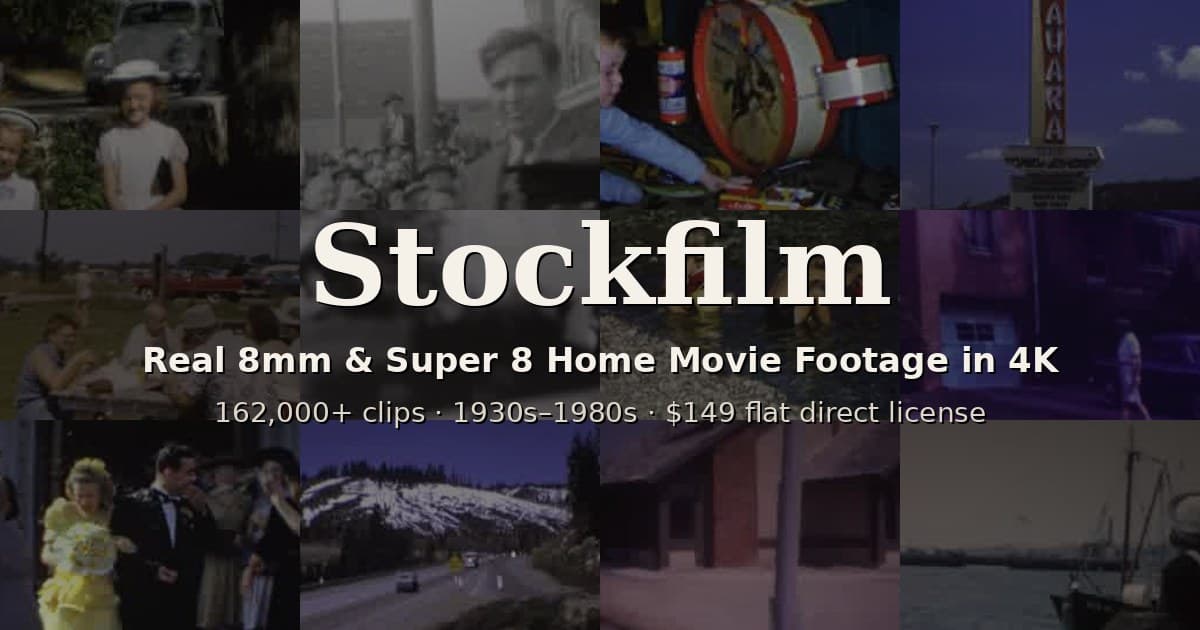
When producers license footage from archives specializing in chemical preservation, they acquire more than aesthetic texture. They obtain materials with built-in provenance chains. The photochemical reaction that created the image occurred at a specific historical moment; the resulting emulsion cannot be reverse-engineered to convincingly fake a 1970s capture date without detection by modern conservation analysis. The organic decay patterns, specific to film chemistry and environmental exposure, create a natural timestamp that digital files simply cannot replicate.
This physical certainty matters for projects requiring temporal specificity. A documentary examining cultural shifts between 1968 and 1972, for instance, cannot risk incorporating footage of ambiguous origin. The visual grammar of chemically-processed film—from color fade patterns to registration stability—provides immediate visual cues that support scholarly and journalistic verification, distinguishing authentic period material from digitally-created "vintage effects."
Practical Applications for Production Teams
For buyers navigating this landscape, the sourcing equation has evolved beyond resolution and framing. Production teams are now implementing "provenance audits" as standard pre-licensing protocol. When evaluating archival vendors, consider the following verification layers:
- Chain of Custody Documentation: Look for archives that provide acquisition history from original camera negative to digital scan. Transparent archive methodologies should detail how material was stored, transferred, and digitized without intermediate alterations that could compromise temporal evidence.
- Chemical Dating Markers: Prioritize vendors who can provide technical specifications of the original film stock (manufacturer date ranges, emulsion types) that correlate with the depicted content. Kodachrome, Ektachrome, and various negative stocks were produced in distinct eras with identifiable chemical signatures.
- Platform Compliance Preparation: With distribution platforms increasingly requiring authenticity verification for monetized content, sourcing footage with immutable temporal evidence protects against demonetization or removal due to suspected AI generation.
- Editorial Liability Protection: For news illustration and documentary contexts, footage with verified chemical provenance provides defensible evidence of good-faith reporting if attribution questions arise post-publication, shielding producers from the correction cycles that recently plagued major news networks.
These considerations prove particularly valuable for documentary series working with streaming distributors who have implemented strict fact-checking protocols in response to recent misinformation controversies.
The Licensing Provenance Stack
The market is responding to these pressures by bifurcating. Generic "vintage look" footage—digitally degraded to appear aged—carries significant liability risk in professional contexts where temporal accuracy is paramount. Conversely, footage with documented chemical origins commands premium positioning not merely for aesthetic authenticity, but for editorial safety and legal protection.
Forward-thinking producers are now building "provenance stacks" in their deliverables: comprehensive documentation packages that accompany licensed archival material, establishing the impossibility of AI generation or temporal misattribution. This documentation becomes a transferable asset, adding value at each subsequent licensing tier while protecting downstream distributors from costly correction cycles and reputational damage.
Frequently Asked Questions
How can producers distinguish between authentic 8mm footage and digitally-created "vintage" effects?
Authentic 8mm film exhibits specific photochemical characteristics including organic grain noise patterns, chromatic aberration in highlights, and registration weave that differ algorithmically from digital filters. When licensing, request technical specifications regarding the original film stock and digitization process. Reputable archives provide codec information and scanning resolutions that indicate legitimate film-to-digital transfer rather than synthetic generation. The presence of film weave, gate hair, and organic light halation provide visual tells that remain difficult to replicate convincingly through digital post-production.
What documentation should documentary teams request when licensing archival footage for international distribution?
Beyond standard rights clearances, teams should request chain-of-custody documentation, chemical analysis reports for the film stock, and digitization protocols. For sensitive geopolitical or historical subjects, additional verification of the footage's capture date through camera-original edge codes or production notes provides essential protection against factual challenges. Some archives also provide affidavits of authenticity that satisfy broadcaster indemnification requirements.
Does sourcing chemically-verified footage limit creative options compared to AI generation or digital archives?
While analog archives constrain manipulation possibilities, this constraint proves creatively liberating for many productions. The temporal certainty of chemical film allows producers to construct narratives with confidence in their historical foundation, eliminating the second-guessing that now accompanies digital sources. Furthermore, the organic texture of 8mm footage provides visual distinction in a marketplace saturated with digitally homogeneous content, offering aesthetic differentiation alongside verification benefits that protect project integrity.
Conclusion
The Fox News apology and the ongoing AI verification crisis represent market corrections rather than isolated incidents. They signal an industry-wide recalibration toward material evidence in visual storytelling. For producers, editors, and archival researchers, the mandate is clear: in an environment where digital content faces existential questions about its origin and date of creation, chemically-processed film offers something increasingly rare—an unambiguous relationship to time itself. The footage isn't merely old; it is temporally anchored, providing the certainty required for credible storytelling in an uncertain media landscape.