01 / Proposal
Project summary
The Sounds We Lost invites visitors to compose possible soundscapes around real home movies of urban life. A person approaches a car; traffic crosses a museum frontage; a drink is offered beside a parked vehicle. First the film plays without added sound. Two artist studies then shift attention between small foreground details and movement beyond the frame. Visitors can adjust four sound layers, return to silence, and compare what they heard with what the image actually supports. The film stays the same. Its apparent meaning changes.
Phil Maher / Stockfilm proposes a compact, screen-based listening station for Sound Scene 2027: Sounds of the City. Headphones contain most sound, while descriptions and a textual soundscape provide other ways into the work. This independent proposal includes a working browser prototype using locally generated and edited sound effects. It does not present a recovered historical soundtrack. Recorded sound production, physical device testing and venue approval remain separate production stages.
02 / Proposal
Artist statement
A home movie is already a decision about attention. Someone points a camera, starts it, stops it, and keeps the reel. Private gestures enter a public record unevenly. Film can preserve a hand near a car door with remarkable immediacy while telling us little about who held the camera or what happened outside the frame. I want to make that unevenness perceptible without making the surviving image feel remote.
Sound arrives with its own authority. A close impact makes a person feel near. A low motor texture can give a street a scale the picture alone does not establish. We often accept that relationship before we have asked where the recording came from. Here, the added soundtrack declares its status throughout. The visitor is invited to hear the persuasive force of a composition and then examine the choices that created it.
The title names an absence in our encounter with these images. It does not claim that every sound disappeared, that every source reel was silent, or that the past was quieter or kinder. Some historical recordings survive. Some details remain unknowable. Silence and omission belong in the work because they keep that uncertainty audible. There is no correct mix to uncover, and restraint is as consequential as adding another layer.
03 / Proposal
Relationship to Sounds of the City
Cities are heard from positions: beside a person, behind a window, across a road, beneath an unseen mechanism. The work makes those positions available as choices. Its palette concerns proximity, infrastructure and attention rather than assigning an emotional identity to a neighborhood. A foreground gesture can occupy the whole listening field, or the larger city can carry on around it.
The three studies move between a Chicago street sequence, a gathering cataloged as New York City, and a moving view of a D.C. museum frontage. The gathering is especially useful: it asks where public urban life ends and a private exchange begins. The film itself does not settle that boundary. The visitor can make the city seem present or almost absent by deciding what belongs beyond the frame. No language, conversation, occupation or social identity is inferred from anyone's appearance.
04 / Proposal
Visitor experience
At arrival, a still and a short invitation establish the action: look, then choose where to listen. The first Play starts the selected film without added sound. A label identifies its source and estimated date. The visitor can then hear either artist study at the current image position. Smooth gain changes keep the comparison continuous, while the visitor's own settings remain available through Return to your mix.
Four plain controls invite a small composition. Each has an on/off switch, intensity slider, isolated audition, sound description and evidence note. A visitor can leave every layer off. An evidence reveal separates visible cues, contextual support and freely imagined choices. The closing prompt asks what the sound made the visitor believe. An optional reflection stays only in the current page's memory and is cleared by reset or departure.
A 60–90 second sampler and a 3–5 minute deeper encounter are design targets, not measured dwell times. The source excerpts are 5.005 seconds each and repeat at delivered speed. This deliberate short form supports comparison without pretending to offer a longer continuous event. For one station, assuming a three-minute visit, a 30-second changeover and 70% utilization, planning capacity is 60 ÷ 3.5 × 0.7 = 12 visits per hour. Two independently staffed stations under those assumptions would offer 24 visits per hour. These are capacity calculations, not attendance forecasts.
05 / Proposal
Selected material and archival method
The current selection uses actual Stockfilm masters and public clip records, inspected as moving images on 7 October 2026. Each delivery is a 960 × 540 H.264 derivative with the film gate retained. No frames are generated or interpolated. The masters inspected here contain no audio stream; that technical observation does not establish whether the source film originally carried sound. The source register keeps catalog confidence and reel-link confidence distinct.
Chicago, clip 125593798, moves from a person beside a blue car to a crowded street with a CHICAGO sign. The cut is disclosed. The catalog estimates 1968 and Chicago. Candidate reel 1018 carries 1968 and a note mentioning both Chicago and Mackinac Island; it is not a documented digitization link. The New York study, clip 124557771, shows a tray, bottle, small vessels and a brief exchange beside a car. Its 1956 and New York City labels remain estimates; no reel is linked. D.C., clip 121472189, shows passing traffic, a museum inscription and fountain spray through a window. The catalog estimates 1975 and Washington, with no linked reel.
The owner explicitly authorized project web presentation, added sound, exhibition and offline caching in this task. That authorization is recorded separately from the clips' editorial-only catalog categories. Depicted people and trademarks still require review in the final exhibition context. The first research lead with conflicting Chicago/Morton notes was not selected. No marketplace license is assumed. The current sound palette uses Stable Audio Open effects generated on two local RTX 3090 Ti GPUs, selected from alternative takes and edited into 15.015-second loops. These sounds are AI-generated, not field recordings or recovered history. A public production record identifies prompts, seeds, selected takes, filtering, level treatment and model terms. Stockfilm confirmed revenue eligibility and existing Community License registration. Headphone listening and artistic sign-off remain a separate review gate. Finished field recordings or Foley will need their own creator, terms, transformations and scope records before replacement.
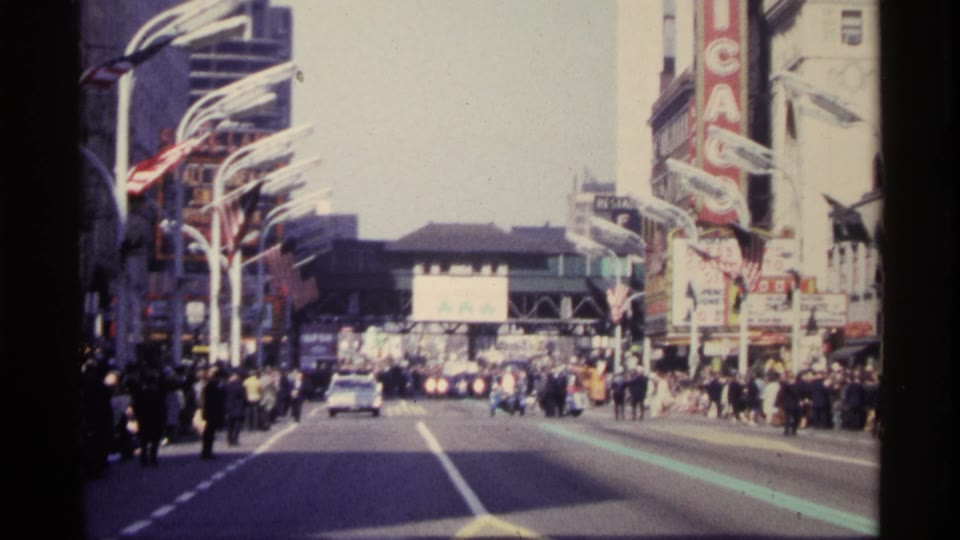
Study 01 / 1968 · estimated
Beside the car. Beyond the curb.
Chicago, Illinois · catalog estimate.
The 5.005-second archive clip contains a cut between two views. It loops at its delivered speed. It is not one continuous event. Delivery: 960 × 540 H.264; no added frames or removed gate edges.
Candidate reel 1018; year note 1968; location note ‘chicago,macinaw island michigan’. This is a catalog match, not a documented digitization link.
The inspected digital master has no audio stream. Whether the source film originally carried sound has not been established.
Visual description & open evidence
In a color home movie, a person wearing a dark coat and hat stands beside a blue car on a street with bare trees. The person moves toward the open car door. A bright exposure flare crosses the image. The film cuts to a view down a busy street. Cars and people fill the lower part of the frame, and a tall vertical sign reads CHICAGO on the right. Dark film edges remain visible. The short sequence repeats.
Who filmed it, exact date and street, original sound status, and a documented clip-to-reel link.
Documentation record ↗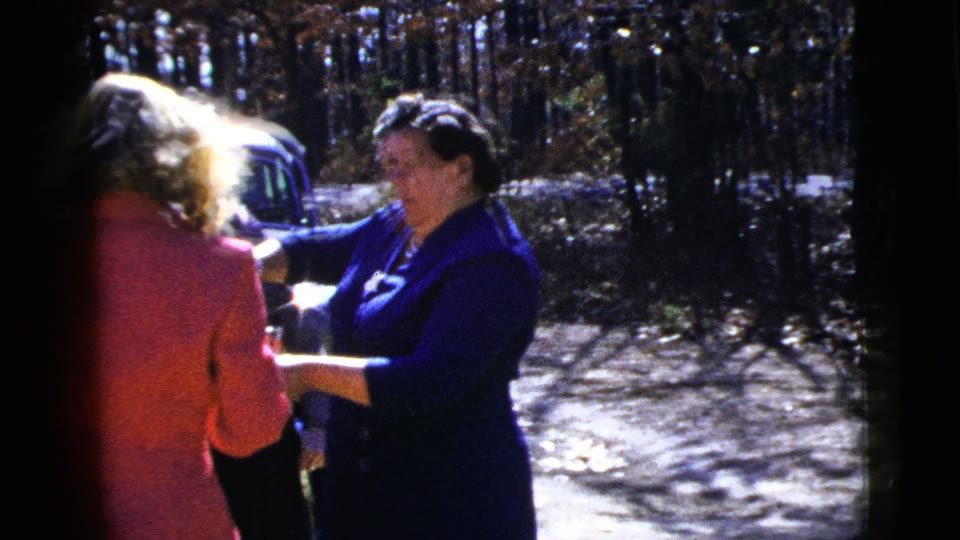
Study 02 / 1956 · estimated
A small gesture, an unseen city.
New York City · catalog estimate.
One 5.005-second archive excerpt, repeated at its delivered speed. 960 × 540 H.264 delivery. No added frames. This gathering is cataloged as New York City; the frame alone does not identify the city.
No reel record is linked in the public catalog. The location is not independently established by the image.
The inspected digital master has no audio stream. Whether the source film originally carried sound has not been established.
Visual description & open evidence
In a color home movie outdoors, a person in dark blue holds a tray with small vessels and a bottle. A person in a coral-colored suit stands with their back partly toward the camera, then turns and smiles. Another person is partly visible behind them. A blue car, a fence and trees occupy the background. Dark vertical film edges frame the gathering. The short gesture repeats. No conversation has been assigned to these people.
Exact place, identities, occasion, material of the vessels, original sound and source reel.
Documentation record ↗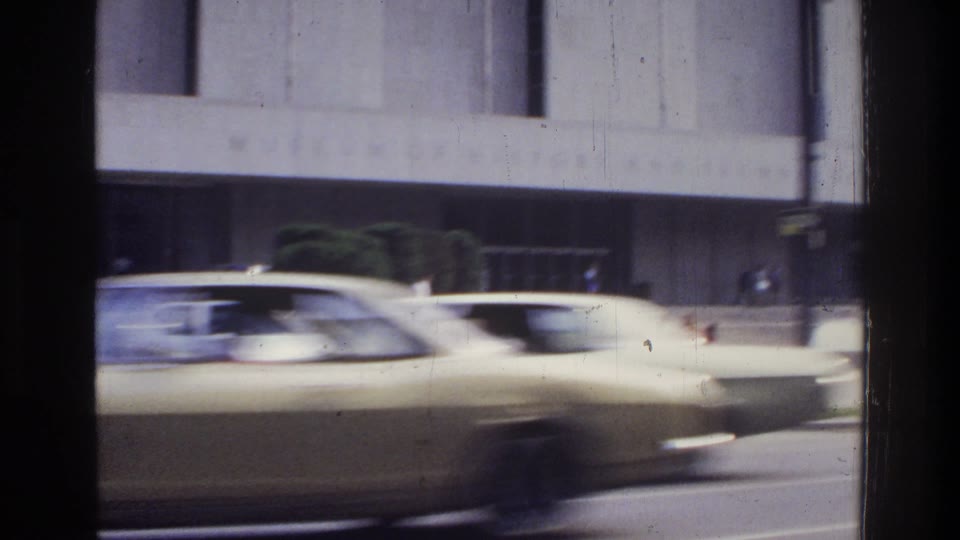
Study 03 / 1975 · estimated
Traffic, water, and a window.
Washington, D.C. · catalog estimate.
One 5.005-second moving-camera excerpt, repeated at its delivered speed. 960 × 540 H.264 delivery; no added frames. A window edge obstructs part of the view.
No source reel is linked. The public record retains estimated date and location.
The inspected digital master has no audio stream. Whether the source film originally carried sound has not been established.
Visual description & open evidence
In a color home movie, the camera looks through a dark-edged vehicle window across a road. A car and a red delivery truck pass in the foreground. The view moves along a pale building with an inscription reading Museum of History and Technology. Small people stand or walk near its front. More cars cross the image; near the end, white fountain sprays appear behind them. The short view repeats.
Camera operator, exact day, vehicle, original sound and source reel.
Documentation record ↗06 / Proposal
Physical installation
The lean version is one listening station: a bright 22–24 inch display, a local playback computer, large button and slider controls, and two cleanable headphone options. A visitor sees the screen and palette together. A short source label sits beside the station, with a printed description and soundscape cards available to hold. The screen supplies its own light; wall projection and a darkened room are unnecessary.
The concept schematic below reserves a 1.8 × 1.8 metre planning envelope for a station, an adjustable table and approach space. A seated and a standing approach are proposed. These dimensions are planning allowances to review with the venue's access team, not an approved floorplan or a claim of regulatory clearance. Cables follow a protected route away from circulation. An expanded version adds a second independent station, subject to placement, staffing, budget and clearance of circulation. It does not simply split the same audio feed.
07 / Proposal
Accessibility and facilitation
The digital design targets applicable WCAG 2.2 AA requirements. Native buttons, switches and sliders support keyboard use, visible focus and readable values. The textual soundscape describes selected layers, relative intensity and spatial intent. A visitor can compare the compositional choices without relying on a waveform or hearing every frequency. There is no speech attributed to the people on film, no forced playback and no motion-dependent interaction.
Each study has an authored visual description and an extended description action: playback pauses while an available browser voice reads it aloud. Narration does not compete with the soundscape. Voice availability and quality vary, so final recorded descriptions and an independent access review are production requirements. A text transcript alone is not claimed to meet every audio-description requirement. Visitors can stop narration or return to silence at any time.
Physical access will include reachable controls, legible large-print instructions, seated participation and facilitator assistance. Headphones are optional. A textual comparison and description-first encounter are available; a low-level directional output or compatible assistive listening arrangement is proposed only after discussion of venue equipment, access needs and sound bleed. The facilitator explains the distinction between evidence and composition, helps reset controls, and never treats hearing or historical guessing as an entry test.
08 / Proposal
Technical rider and operations
Proposed equipment: one computer running a supported current browser, one bright screen, touch input or keyboard and pointer, two cleanable headphones, a suitable output interface if the device cannot drive them reliably, adjustable furniture, power strip, protected cables, signage and spares. An outlet is required for the base design. The planning power allowance is 35 W for playback, 22 W for display and 3 W for audio, totaling 60 W nominal; reserve 75 W with margin. These are estimates to replace with measurements of the selected equipment. An all-day battery version is not promised.
The kiosk reuses the studio and stores no visitor identity or reflection. Staff choose a one-, two-, five- or fifteen-minute idle timeout. A 20-second warning offers Keep composing before reset. Offline preparation checks asset permissions, caches only this kiosk's shell, code and approved local media, and verifies media hashes. It is an explicit device operation. A fresh disconnected reload and playback of every study are required before declaring a device ready. Browser reading voices may remain unavailable offline.
Allow 90 minutes for a proposed setup and sound check, then confirm the real window with organizers. Check film loading, output levels, keyboard operation, narration and reset; start with conservative volume, without claiming software gain establishes safe headphone sound pressure. Between visitors, clean contact surfaces using material-compatible supplies. A designated person monitors operation and access requests. Keep a spare input device, adapter, headphones and a tested local backup. Teardown includes disabling playback, collecting labels, inspecting equipment and packing cables. No institution's schedule, insurance approval or equipment commitment is assumed.
09 / Proposal
Budget and resources
The figures below are illustrative USD planning allowances, calculated from quantities and rates. They are not supplier quotes or committed funding. The lean scenario requires a local representative who has not been appointed; the second assumes Phil travels. Screen, computer, primary headphones and furniture are proposed in-kind resources only. If borrowing fails, their estimated replacement value must become additional cash cost.
Creator labor is counted separately so the funding gap does not disguise unpaid work. The published honorarium is $500–$1,500 if a work is selected; travel and lodging are not separately funded. The table shows both ends of that range without assuming an award. Insurance, shipping, airfare, sound production and access consultation need quotes. Any expanded station needs its own equipment and staffing revision.
| Resource | Qty | Unit | Subtotal |
|---|---|---|---|
| Sound practitioner (hours; proposed) | 16 | $35.00 | $560.00 |
| Access adviser (hours; proposed) | 6 | $50.00 | $300.00 |
| Spare cleanable headphones | 1 | $65.00 | $65.00 |
| Hygiene supply packs | 2 | $20.00 | $40.00 |
| Cables and adapters allowance | 1 | $35.00 | $35.00 |
| Large-print signage | 1 | $25.00 | $25.00 |
| Return freight allowance | 1 | $150.00 | $150.00 |
| Insurance allowance; quote needed | 1 | $150.00 | $150.00 |
| Local representative (hours; unappointed) | 16 | $30.00 | $480.00 |
| Local travel allowance | 1 | $60.00 | $60.00 |
| Subtotal | $1,865.00 | ||
| Resource | Qty | Unit | Subtotal |
|---|---|---|---|
| Sound practitioner (hours; proposed) | 16 | $35.00 | $560.00 |
| Access adviser (hours; proposed) | 6 | $50.00 | $300.00 |
| Spare cleanable headphones | 1 | $65.00 | $65.00 |
| Hygiene supply packs | 2 | $20.00 | $40.00 |
| Cables and adapters allowance | 1 | $35.00 | $35.00 |
| Large-print signage | 1 | $25.00 | $25.00 |
| Return freight allowance | 1 | $150.00 | $150.00 |
| Insurance allowance; quote needed | 1 | $150.00 | $150.00 |
| Airfare allowance | 1 | $700.00 | $700.00 |
| Lodging nights | 3 | $180.00 | $540.00 |
| Ground transport allowance | 1 | $120.00 | $120.00 |
| Baggage allowance | 1 | $100.00 | $100.00 |
| Subtotal | $2,785.00 | ||
| Calculated amount | Local representative | Phil attends |
|---|---|---|
| Cash before contingency | $1,865.00 | $2,785.00 |
| Contingency, 15% | $279.75 | $417.75 |
| Total cash cost | $2,144.75 | $3,202.75 |
| Cash gap with $500 honorarium | $1,644.75 | $2,702.75 |
| Cash gap with $1,500 honorarium | $644.75 | $1,702.75 |
| Creator labor value | $3,420.00 | $4,680.00 |
| In-kind equipment value | $1,520.00 | $1,520.00 |
| Full economic cost | $7,084.75 | $9,402.75 |
| Resource | Qty | Unit | Subtotal |
|---|---|---|---|
| Playback computer | 1 | $900.00 | $900.00 |
| Display | 1 | $300.00 | $300.00 |
| Primary headphones | 2 | $70.00 | $140.00 |
| Adjustable furniture | 1 | $180.00 | $180.00 |
| Subtotal | $1,520.00 | ||
| Resource | Qty | Unit | Subtotal |
|---|---|---|---|
| Evidence and curation (hours) | 20 | $45.00 | $900.00 |
| Software and testing (hours) | 32 | $45.00 | $1,440.00 |
| Composition and production coordination (hours) | 24 | $45.00 | $1,080.00 |
| Subtotal | $3,420.00 | ||
Phil-attends labor adds 28 travel and festival hours at $45/hour ($1,260.00). Cash consultation and sound-practitioner hours are additional proposed roles. In-kind values are planning replacement allowances; unavailable loans add cash cost. No purchases, bookings or appointments have been made.
10 / Proposal
Production schedule and risks
By 31 October 2026, Phil will review clip evidence, record use-specific concerns and choose whether to keep the short studies or license longer coherent material. By 10 November, refine the application narrative and verify the portal fields and linked venue policies. The published deadline is 15 November 2026. No application has been submitted by this prototype.
If selected, December–February is proposed for sound commissioning, creator contracts and first recordings. March covers integration and an independent access review. April covers target-device tests, offline rehearsal and revised budget. May covers venue placement, power, assistive access, insurance, representative attendance and setup confirmation. A final rehearsal in late May should include a disconnected restart, an interrupted video, rapid control input and a full visitor reset. Proposed delivery is 5–6 June 2027, subject to selection and agreement.
Phil owns curation, software acceptance and production coordination. Sound practitioner, access adviser and local representative are unappointed paid roles. The main dependencies are funding, permissions for replacement recordings, hardware availability and venue decisions. Short excerpts may feel repetitive; observation with visitors will determine whether a longer study is needed. Technical failure should leave a legible description and clear retry path, while stopping added sound. Loss of staffing, unresolved access or unsuitable placement requires revising the presentation rather than claiming readiness.
11 / Proposal
Artist biography and collaborators
Phil Maher founded Stockfilm in 2015 after encountering home movies made by his grandfather around Chicago and on family trips. He runs the archive's work in sourcing, scanning, restoration and licensing. Stockfilm preserves real 8mm and Super 8 home movies, with published standards for uncertain metadata and candidate reel matches. This project grows from that practice of making small surviving moments available for renewed attention. The public Stockfilm biography is the source for these facts; no festival history or professional sound-art credential is invented.
Current authorship is Phil Maher / Stockfilm. The implementation, generated-effect production and editing were developed with Codex assistance. A sound artist, an accessibility adviser and, if needed, a D.C. representative are proposed roles, not confirmed collaborators. A historian could help contextualize future city studies, but no expert review is claimed for this build.
12 / Proposal
Credits, sources, and open questions
Archival image credit: Stockfilm, clips 125593798, 124557771 and 121472189. Still images are frames from those sources. Current added sound consists of AI-generated effects made locally with Stable Audio Open and edited for this work; none is a location recording or recovered soundtrack. No dialogue is assigned to people in the images. The generation brief excludes music and speech; machine screening does not replace a listening review. The source register links each actual record and records viewing, delivery alterations, uncertain dates, reel status and approved scopes.
Sound Scene's current RFP was rechecked on 7 October 2026. It invites installations, performances and small-group workshops at the Hirshhorn in Washington, D.C., on 5–6 June 2027. The proposal responds to that invitation independently. Organizers need to confirm equipment allocation, power and placement, circulation and access coordination, sound-bleed limits, insurance, representative attendance, setup and teardown windows, and documentation rights. SlideRoom's complete application fields and the linked venue policy have not been verified here. No branding permission, selection, commission or partnership is implied.
An optional workshop could use the same method for six to eight participants over 30 minutes: five minutes looking and describing, five comparing two studies, ten composing in pairs, seven discussing evidence and invention, and three closing with a new question. The takeaway is a vocabulary for hearing how attention changes interpretation, not a reconstructed soundtrack. Staffing, equipment and access would need a separate workshop plan; this variant is not assumed to be covered by an installation submission.
- Sound Scene 2027 RFP ↗
Dates, theme, deadline, honorarium, attendance and presentation guidance; checked 7 October 2026.
- Application portal ↗
JavaScript-dependent portal; complete fields not verified. No submission made.
- Stockfilm archive integrity ↗
Rights boundaries, restoration and confidence standards.
- Stockfilm archive methodology ↗
Physical film and candidate clip-to-reel links.
- Phil Maher / Stockfilm biography ↗
Founder and archive practice.
- Stable Audio Open model and license ↗
Open-weight model under Stability Community License; generated audio is new artistic material.
- Sound generation and editing record ↗
Prompts, seeds, model settings, edits, asset hashes and listening-review status.
- Web Audio best practices ↗
Gesture activation, gain changes and user control.
- WCAG overview ↗
Evaluation target, not a conformance certificate.
- Audio description guidance ↗
Authored descriptions and evaluation requirements.
Production readiness
- Browser prototype
- Implemented; validation outcomes in the test report
- Footage permission
- Project owner authorization recorded; depicted-interest exhibition review remains
- Offline software
- Preparation implemented; browser test outcomes recorded separately. Each exhibition device needs a fresh disconnected reload test
- Sound production
- Generated and edited browser palette complete; headphone sign-off and proposed recording commission pending
- Physical hardware
- Proposed; devices and power not measured
- Venue approval
- Not requested or granted; independent proposal
Contact: phil@stockfilm.com. The prototype is unlisted and marked noindex; it is shareable by URL and has no access control.