01 / A city seen through home-movie filmClip 125593798 · Chicago, 1968 (catalog estimates)
No added sound until you choose to listen.
Opening the listening room… Film and sources remain described below.
02 / What survives, what we add
A picture is evidence. A soundtrack makes a claim.
A close footstep can pull someone toward you. A distant engine can turn a small gesture into part of a larger city. Nothing in the picture has moved differently.
These are real archival films. The added sounds are AI-generated sound effects, selected, edited and mixed for this work. They demonstrate composition; they do not reconstruct an original soundtrack.
Every date and location retains its catalog qualification. Each study links its source, names what is visible, and leaves the gaps open.
The 5.005-second archive clip contains a cut between two views. It loops at its delivered speed. It is not one continuous event. Delivery: 960 × 540 H.264; no added frames or removed gate edges.
Candidate reel 1018; year note 1968; location note ‘chicago,macinaw island michigan’. This is a catalog match, not a documented digitization link.
The inspected digital master has no audio stream. Whether the source film originally carried sound has not been established.
Visual description & open evidence
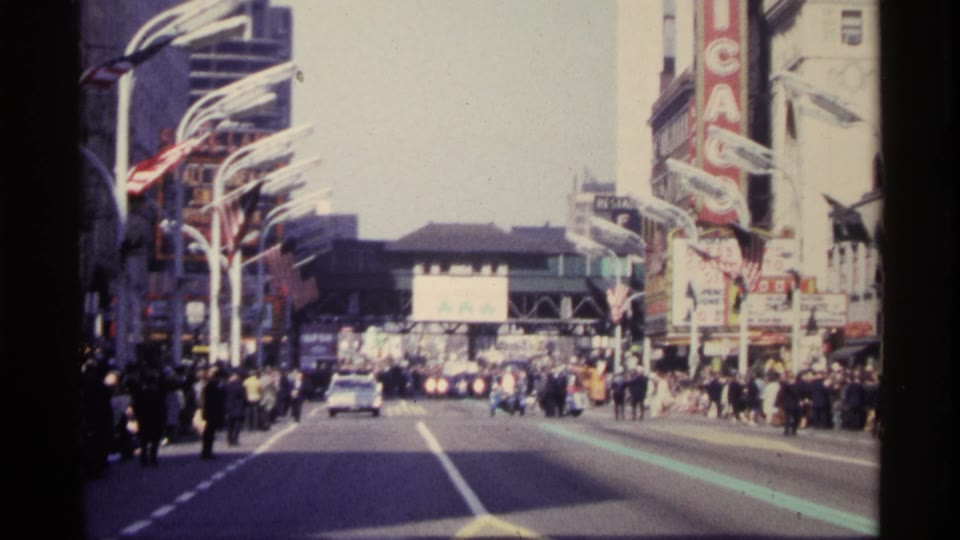
In a color home movie, a person wearing a dark coat and hat stands beside a blue car on a street with bare trees. The person moves toward the open car door. A bright exposure flare crosses the image. The film cuts to a view down a busy street. Cars and people fill the lower part of the frame, and a tall vertical sign reads CHICAGO on the right. Dark film edges remain visible. The short sequence repeats.
Who filmed it, exact date and street, original sound status, and a documented clip-to-reel link.
One 5.005-second archive excerpt, repeated at its delivered speed. 960 × 540 H.264 delivery. No added frames. This gathering is cataloged as New York City; the frame alone does not identify the city.
No reel record is linked in the public catalog. The location is not independently established by the image.
The inspected digital master has no audio stream. Whether the source film originally carried sound has not been established.
Visual description & open evidence
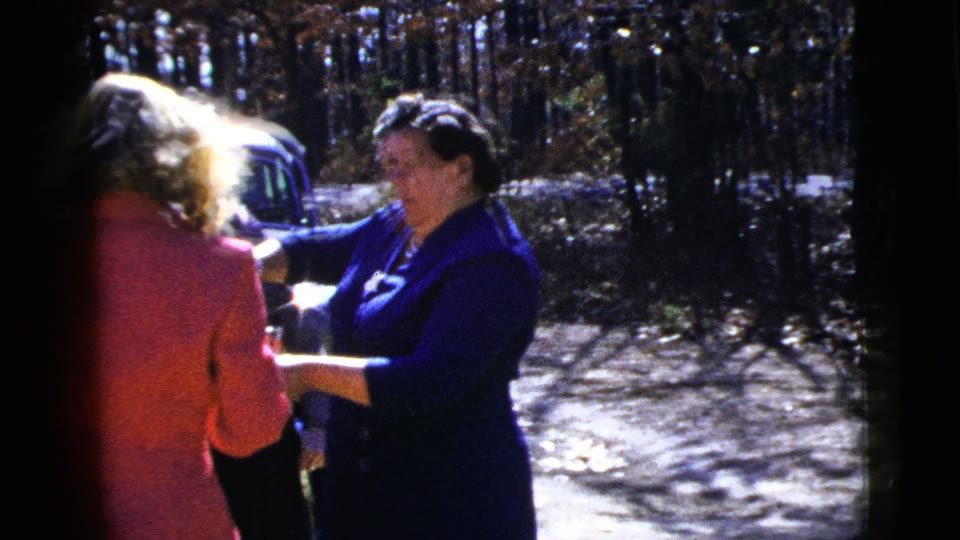
In a color home movie outdoors, a person in dark blue holds a tray with small vessels and a bottle. A person in a coral-colored suit stands with their back partly toward the camera, then turns and smiles. Another person is partly visible behind them. A blue car, a fence and trees occupy the background. Dark vertical film edges frame the gathering. The short gesture repeats. No conversation has been assigned to these people.
Exact place, identities, occasion, material of the vessels, original sound and source reel.
One 5.005-second moving-camera excerpt, repeated at its delivered speed. 960 × 540 H.264 delivery; no added frames. A window edge obstructs part of the view.
No source reel is linked. The public record retains estimated date and location.
The inspected digital master has no audio stream. Whether the source film originally carried sound has not been established.
Visual description & open evidence
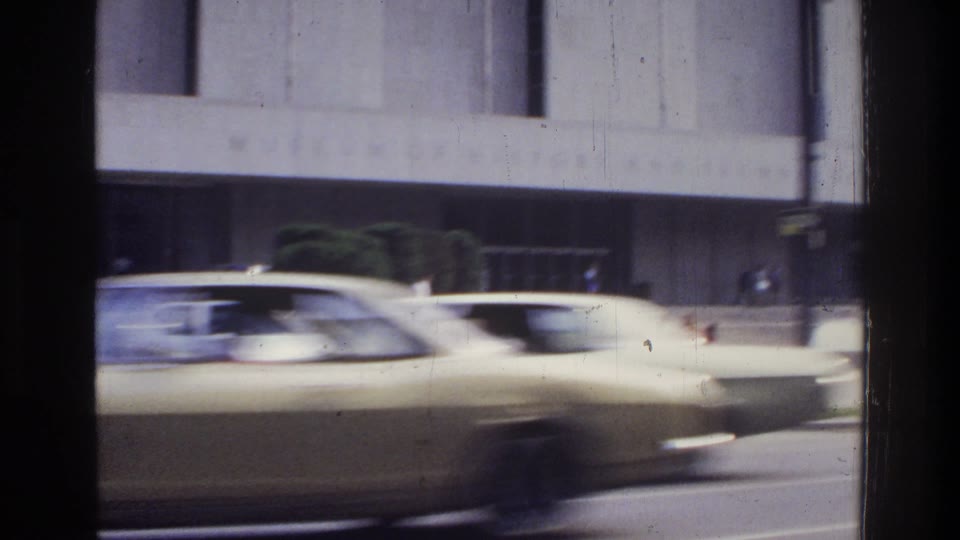
In a color home movie, the camera looks through a dark-edged vehicle window across a road. A car and a red delivery truck pass in the foreground. The view moves along a pale building with an inscription reading Museum of History and Technology. Small people stand or walk near its front. More cars cross the image; near the end, white fountain sprays appear behind them. The short view repeats.
Camera operator, exact day, vehicle, original sound and source reel.
One screen. Four sound layers. Headphones, if you want them. A first encounter in 60–90 seconds, or a deeper visit of 3–5 minutes. These are design targets.
Proposed for Sound Scene 2027: Sounds of the City. No selection, institutional endorsement or venue approval is implied.
Concept only. A planning schematic, not a photograph or approved museum floorplan.
Look
Begin with the film and no added sound.
Listen
Try two choices of distance and attention.
Compose
Leave space. Return to silence.
Question
Ask what the sound made you believe.
04 / Access and practical care
More than one way in
Keyboard controls, visual descriptions read aloud on request, and a textual soundscape. Pause, silence and description-first viewing are always available.
Contained, screen-based sound
A headphone-led station with seated and standing approaches. Optional assistive listening and alternative output need venue coordination. The base design requires an outlet.
Separate readiness stages
Working software does not establish finished sound production or a tested physical installation. The proposal names the budget, access review, hardware tests and approvals still needed.
05 / Artist’s position
Keep the gaps open.
The title names an absence in our encounter with these images. It does not claim that every sound disappeared, that every source reel was silent, or that the past was quieter or kinder. Some historical recordings survive. Some details remain unknowable. Silence and omission belong in the work because they keep that uncertainty audible. There is no correct mix to uncover, and restraint is as consequential as adding another layer.
Phil Maher founded Stockfilm in 2015 after encountering his grandfather’s home movies. He runs its sourcing, scanning, restoration and licensing work. The Sounds We Lost grows from that practice of attending to small surviving moments.
Image: Stockfilm. Sound direction: Phil Maher / Stockfilm. Stable Audio Open effects, editing and implementation: Codex-assisted production under Phil Maher’s project direction. Proposed sound and access collaborators have not been appointed.
In a color home movie, a person wearing a dark coat and hat stands beside a blue car on a street with bare trees. The person moves toward the open car door. A bright exposure flare crosses the image. The film cuts to a view down a busy street. Cars and people fill the lower part of the frame, and a tall vertical sign reads CHICAGO on the right. Dark film edges remain visible. The short sequence repeats.
Extended description: the film pauses while a browser voice reads this authored text. No narration competes with the mix. Voice availability varies; an exhibition description recording and access review remain planned.
Change your attention
Listen to an artist study
Compose your own
Four layers. Room for silence.
AI-generated effects, selected and edited for this work. Switches and levels edit your mix; press Play to listen.
Sound & evidence
A low motor texture swells, moves across the stereo field and recedes.
AI-generated sound effect. Visible cue in the film.
Cars move in the second shot. Their engines and exact timing were not recorded here.
Middle distance, left to right. New AI-generated sound effect, edited for The Sounds We Lost. Artistic direction: Phil Maher / Stockfilm.
Sound & evidence
Close, dry shoe taps and scuffs, with irregular spaces between steps.
AI-generated sound effect. Visible cue in the film.
People are visible. The rhythm, footwear and proximity are imagined; impacts are not tied to anyone's steps.
Near, slightly left. New AI-generated sound effect, edited for The Sounds We Lost. Artistic direction: Phil Maher / Stockfilm.
No source machine is identified. This texture asks how an unseen rhythm changes the street.
Far, slightly right. New AI-generated sound effect, edited for The Sounds We Lost. Artistic direction: Phil Maher / Stockfilm.
Textual soundscape / hearing access
Without added sound. Playback is paused; these are the selected sounds. Master volume 50%.
No added sound. Look at the movements without an audible interpretation.
The image did not change.
What did the sound make you believe?
Visible
A person, a car door, moving street traffic, a cut, and a CHICAGO sign.
Contextually supported
The catalog and candidate reel note support Chicago as an estimate. They do not document this street or this sound.
Imagined
Footstep spacing, engine texture, wind, mechanical rhythm and listening distance.
This reflection stays in this page’s memory. It is never submitted or included in a mix link; reset or leave to clear it.
What survives / what we add · source record
The preserved image
The 5.005-second archive clip contains a cut between two views. It loops at its delivered speed. It is not one continuous event. Delivery: 960 × 540 H.264; no added frames or removed gate edges.
The inspected digital master has no audio stream. Whether the source film originally carried sound has not been established.
Candidate reel 1018; year note 1968; location note ‘chicago,macinaw island michigan’. This is a catalog match, not a documented digitization link.
Still unknown: Who filmed it, exact date and street, original sound status, and a documented clip-to-reel link.
Public catalog: editorial only; people and logos flagged, no minors flagged. Automated flags are screening aids, not clearance findings.
New sound effects generated locally with Stable Audio Open, then selected, filtered, loop-edited and mixed under Phil Maher’s project direction with Codex assistance. These are generated interpretations, not field recordings or recovered sound. Fifteen-second sound loops span three image repetitions; events are not synchronized to people in the film. Gain, distance and omission are compositional choices.
Project owner authorization recorded 7 October 2026 covers web presentation, added soundtrack, exhibition and offline caching. Downloadable mixes and sound assets are excluded. Catalog license categories remain unchanged; use-specific interests still need exhibition review.